
Contents
Overview
The Toltec civilization, flourishing in Mesoamerica during the Epiclassic period, centered its power in the magnificent city of Tula in modern-day Hidalgo, Mexico. Revered by later cultures, particularly the Aztecs, as intellectual and cultural progenitors, the Toltecs were associated with unparalleled craftsmanship and sophisticated societal structures. The Nahuatl term 'Toltec' itself evolved to mean 'artisan,' a testament to their perceived mastery. While the Aztecs chronicled Toltec rulers and their deeds, the historical accuracy of these accounts remains a subject of intense scholarly debate, with many viewing the Toltec legacy through a lens of myth and cultural idealization. Their influence, however, is undeniable, shaping religious practices, architectural styles, and political ideologies across Mesoamerica, leaving an indelible mark on the region's rich historical tapestry.
🎵 Origins & History
The Toltec civilization emerged in Mesoamerica during the Epiclassic period. The Aztecs viewed Tula as the epitome of civilization and its inhabitants as master artisans. Aztec oral traditions and pictographic codices meticulously documented Toltec history, cementing the Toltec legacy in the Mesoamerican consciousness. However, the precise nature of their political organization and the extent to which these historical accounts reflect verifiable events are subjects of ongoing scholarly scrutiny.
⚙️ How It Works
The Toltec state was characterized by a complex socio-political structure. Archaeological evidence from Tula reveals impressive architectural achievements, including the iconic Atlantean figures, massive basalt columns depicting warriors, and the Temple of Tlahuizcalpantecuhtli. These structures suggest a militaristic society with a strong emphasis on religious ritual and astronomical observation. The Toltecs are also credited with advancements in metallurgy, particularly in gold and silver working, and sophisticated agricultural techniques. Their influence extended through extensive trade networks, disseminating their artistic styles, religious iconography, and possibly their political models across Mesoamerica.
📊 Key Facts & Numbers
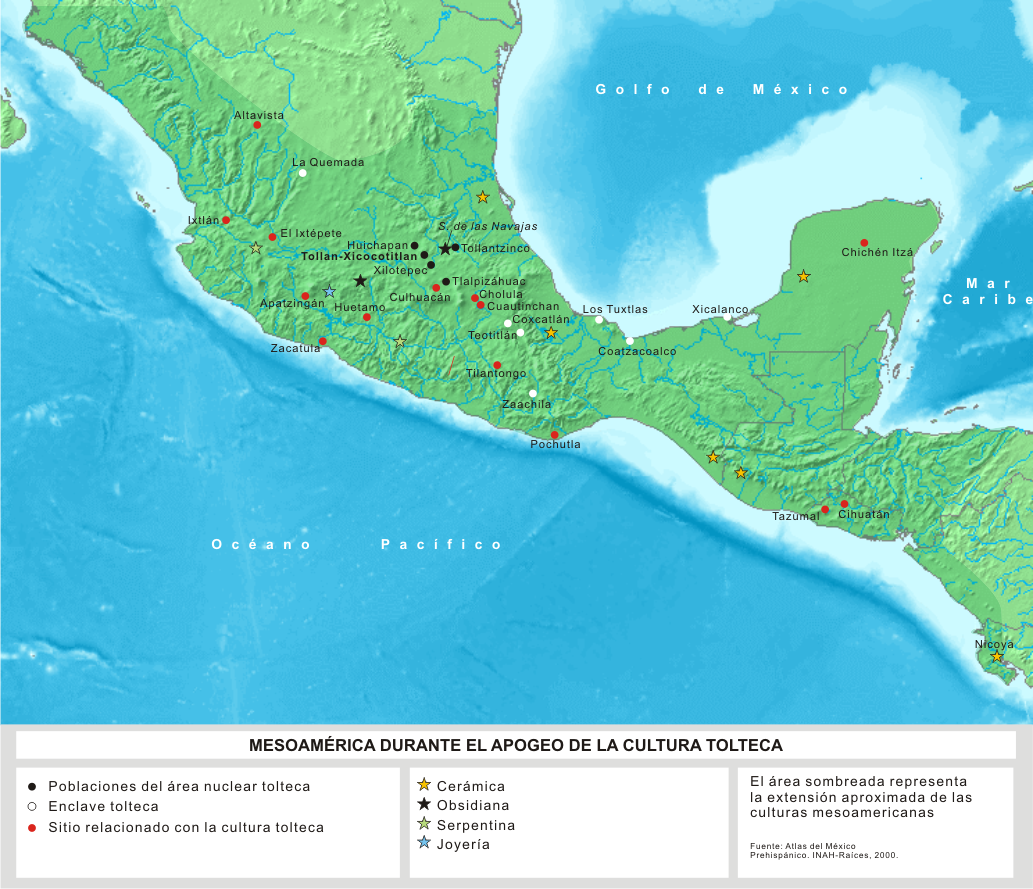
The Toltec civilization controlled a significant portion of central Mexico. The decline of Tula around 1150 CE is often attributed to a combination of internal strife, environmental degradation, and external pressures, though the exact causes remain debated.
👥 Key People & Organizations
While definitive historical records are scarce, the Toltec pantheon and leadership are pieced together through later Mesoamerican accounts. Ce Acatl Topiltzin Quetzalcoatl is deeply intertwined with the god Quetzalcoatl. His story, often depicted in later codices like the Codex Borgia, speaks of his wisdom, his eventual exile, and his prophesied return. Other significant figures, though often shrouded in myth, include Mixcoatl, who is sometimes credited as the father of Topiltzin Quetzalcoatl. Organizations like the National Institute of Anthropology and History (INAH) in Mexico are crucial in the ongoing archaeological research and preservation of Toltec sites like Tula.
🌍 Cultural Impact & Influence
The cultural impact of the Toltecs on subsequent Mesoamerican civilizations, most notably the Aztecs, is profound and undeniable. The concept of the Toltec as the 'Golden Age' of Mesoamerica, a period of unparalleled artistic and intellectual achievement, was heavily promoted by the Aztecs to legitimize their own rule and cultural heritage. Toltec influence can be seen in the ballgame, calendar systems, and even in the political structures of later states. Their legacy is woven into the very fabric of Mesoamerican identity, a testament to their enduring cultural resonance.
⚡ Current State & Latest Developments
The study of the Toltecs is an ongoing process, primarily driven by archaeological excavations and the re-examination of historical texts. Scholars are increasingly employing advanced techniques, such as remote sensing and isotopic analysis, to better understand Toltec migration patterns, trade routes, and environmental interactions. The ongoing debate about the historicity of Aztec accounts of the Toltecs also fuels new research, pushing for more critical interpretations of the available evidence. The preservation of Toltec heritage sites, like Tula, remains a priority for Mexican cultural authorities.
🤔 Controversies & Debates
Some argue that the 'Toltec Empire' as described by the Aztecs may have been more of a cultural sphere of influence than a unified political entity. Theories about Tula's decline include internal conflict, social unrest, environmental collapse, and invasion by nomadic groups from the north, such as the Chichimeca.
🔮 Future Outlook & Predictions
The future outlook for understanding the Toltecs involves a continued synthesis of archaeological findings and critical textual analysis. Researchers anticipate further discoveries at Tula and other related sites that could shed more light on their social structure, economy, and eventual decline. The development of new analytical technologies will likely provide deeper insights into their diet, health, and migration patterns. Furthermore, comparative studies with other Mesoamerican cultures, such as the Maya and Zapotec, may reveal more about the Toltecs' unique contributions and their place within the broader Mesoamerican cultural sphere. The ongoing scholarly dialogue will undoubtedly continue to refine our understanding of this pivotal civilization.
💡 Practical Applications
While the Toltecs are primarily studied for their historical and archaeological significance, their legacy has practical applications in understanding cultural transmission and the construction of historical narratives. The Toltec emphasis on craftsmanship, particularly in metallurgy and stone carving, provides a benchmark for studying ancient artisanal techniques. Their urban planning and architectural innovations at Tula offer valuable case studies for contemporary urban design and heritage preservation. Furthermore, the way the Aztecs constructed their identity by referencing the Toltecs serves as a powerful example in the study of historical memory, propaganda, and the creation of cultural legitimacy, relevant to fields from political science to marketing.
Key Facts
- Category
- history
- Type
- topic