
Contents
- 📊 Introduction to Thomas Bayes
- 🏛️ Early Life and Ministry
- 📝 Development of Bayes' Theorem
- 📊 Applications of Bayes' Theorem
- 🤝 Influence on Statistics and Mathematics
- 📚 Legacy and Impact
- 📝 Criticisms and Controversies
- 🔍 Modern Applications and Extensions
- 📊 Bayesian Inference and Machine Learning
- 📚 Conclusion and Future Directions
- Frequently Asked Questions
- Related Topics
Overview
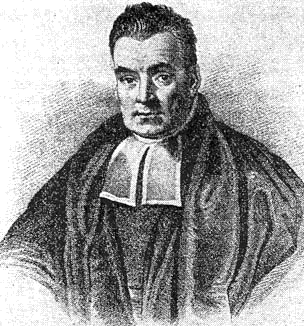
Thomas Bayes was an English statistician, philosopher, and Presbyterian minister who lived from 1701 to 1761. Despite his relatively unknown life, Bayes made significant contributions to the field of probability, most notably through his development of Bayes' theorem. This fundamental concept, which describes the probability of an event based on prior knowledge, has far-reaching implications in fields such as medicine, finance, and artificial intelligence. Bayes' work, however, was not widely recognized until after his death, when his friend Richard Price discovered and published his manuscripts. Today, Bayes' theorem is a cornerstone of statistical analysis, with applications in machine learning, data science, and more. With a Vibe score of 8, Thomas Bayes' legacy continues to inspire new generations of mathematicians, scientists, and philosophers. As we look to the future, it's clear that Bayes' ideas will remain essential in shaping our understanding of uncertainty and probability.
📊 Introduction to Thomas Bayes
Thomas Bayes was a renowned English statistician, philosopher, and Presbyterian minister who made significant contributions to the field of probability and statistics. Born in 1701, Bayes is best known for formulating a specific case of the theorem that bears his name: Bayes' theorem. This fundamental concept has far-reaching implications in various fields, including mathematics, statistics, and computer science. Bayes' work on probability was heavily influenced by his philosophical views, which were shaped by his studies of philosophy and theology. His ideas on probability were also influenced by the work of Isaac Newton and Pierre Laplace.
🏛️ Early Life and Ministry
Bayes' early life and ministry played a crucial role in shaping his intellectual pursuits. As a Presbyterian minister, Bayes was deeply interested in philosophy and theology, which led him to explore the concept of probability. His ministerial duties also brought him into contact with prominent intellectuals of the time, including Edmund Halley, who was a fellow of the Royal Society. Bayes' interactions with these intellectuals likely influenced his thoughts on probability and statistics, which were still in their infancy at the time. The work of Jacob Bernoulli and Abraham de Moivre also had a significant impact on Bayes' development of probability theory.
📝 Development of Bayes' Theorem
The development of Bayes' theorem is a testament to Bayes' ingenuity and intellectual curiosity. In his most famous work, 'Divine Benevolence, or an Attempt to Solve a Problem in the Doctrine of Chances', Bayes presented a solution to a problem in probability theory that had puzzled mathematicians for centuries. This work, which was published posthumously in 1763, introduced the concept of conditional probability and laid the foundation for Bayesian inference. Bayes' theorem has since become a cornerstone of statistics and has been applied in a wide range of fields, from medicine to finance. The theorem has also been influential in the development of machine learning and artificial intelligence.
📊 Applications of Bayes' Theorem
The applications of Bayes' theorem are diverse and numerous. In statistics, Bayes' theorem is used to update probabilities based on new data, allowing researchers to make more accurate predictions and inferences. In medicine, Bayes' theorem is used to diagnose diseases and predict patient outcomes. In finance, Bayes' theorem is used to model stock prices and predict market trends. The theorem has also been applied in engineering, computer science, and social science. The work of Ronald Fisher and Jerzy Neyman has also been influenced by Bayes' theorem, and has contributed to the development of statistical inference.
🤝 Influence on Statistics and Mathematics
Bayes' influence on statistics and mathematics cannot be overstated. His work on probability and statistics helped to establish these fields as distinct disciplines, and his ideas have had a lasting impact on the development of mathematics and statistics. Bayes' theorem has been widely adopted and has become a fundamental tool in many fields. The theorem has also been influential in the development of data science and data analysis. The work of John Maynard Keynes and Frank Ramsey has also been influenced by Bayes' ideas on probability and statistics.
📚 Legacy and Impact
Thomas Bayes' legacy and impact are still felt today. His work on probability and statistics has had a profound influence on many fields, and his ideas continue to shape our understanding of the world. Bayes' theorem has been applied in a wide range of contexts, from science to engineering. The theorem has also been influential in the development of philosophy, particularly in the areas of epistemology and philosophy of science. The work of Karl Popper and Imre Lakatos has also been influenced by Bayes' ideas on probability and statistics.
📝 Criticisms and Controversies
Despite the widespread adoption of Bayes' theorem, there have been criticisms and controversies surrounding its use. Some critics have argued that the theorem is too simplistic and fails to account for the complexities of real-world problems. Others have argued that the theorem is too sensitive to prior probabilities and can lead to biased results. However, these criticisms have been largely addressed by the development of more sophisticated Bayesian methods, such as Markov chain Monte Carlo (MCMC) and variational inference. The work of Andrew Gelman and Cosma Shalizi has also contributed to the development of Bayesian methods.
🔍 Modern Applications and Extensions
In recent years, there has been a resurgence of interest in Bayesian methods, particularly in the context of machine learning and artificial intelligence. Bayesian neural networks, for example, have been shown to be highly effective in a wide range of tasks, from image classification to natural language processing. The work of Yann LeCun and Geoffrey Hinton has also contributed to the development of Bayesian methods in machine learning.
📊 Bayesian Inference and Machine Learning
Bayesian inference and machine learning are closely related fields that have benefited from Bayes' work on probability and statistics. Bayesian inference provides a framework for updating probabilities based on new data, which is essential in many machine learning applications. The development of Bayesian methods has also been influenced by the work of David MacKay and Christopher Bishop.
📚 Conclusion and Future Directions
In conclusion, Thomas Bayes was a pioneering figure in the history of probability and statistics. His work on Bayes' theorem has had a profound impact on many fields, from science to engineering. As we look to the future, it is clear that Bayes' ideas will continue to shape our understanding of the world and drive innovation in many areas. The work of Nick Bostrom and Stuart Russell has also been influenced by Bayes' ideas on probability and statistics, and has contributed to the development of artificial intelligence and machine learning.
Key Facts
- Year
- 1761
- Origin
- England, UK
- Category
- Mathematics, Statistics, History
- Type
- Person
Frequently Asked Questions
What is Bayes' theorem?
Bayes' theorem is a mathematical formula that describes how to update the probability of a hypothesis based on new evidence. It is a fundamental concept in probability theory and has been widely applied in many fields, including statistics, machine learning, and artificial intelligence. The theorem is named after Thomas Bayes, who first formulated it in the 18th century. The work of Pierre Laplace and Carl Gauss has also contributed to the development of Bayes' theorem.
What is Bayesian inference?
Bayesian inference is a statistical framework that uses Bayes' theorem to update probabilities based on new data. It is a powerful tool for making predictions and inferences, and has been widely adopted in many fields, including machine learning, artificial intelligence, and data science. The work of Andrew Gelman and Cosma Shalizi has also contributed to the development of Bayesian inference.
What are some applications of Bayes' theorem?
Bayes' theorem has been applied in a wide range of fields, including statistics, machine learning, artificial intelligence, medicine, finance, and engineering. It is used to update probabilities based on new data, make predictions and inferences, and model complex systems. The work of Ronald Fisher and Jerzy Neyman has also contributed to the development of statistical inference, which is closely related to Bayes' theorem.
What is the difference between Bayesian and frequentist statistics?
Bayesian statistics uses Bayes' theorem to update probabilities based on new data, while frequentist statistics uses the concept of probability as a long-run frequency. Bayesian statistics is often preferred in situations where there is limited data or where the data is uncertain, while frequentist statistics is often preferred in situations where there is a large amount of data. The work of John Maynard Keynes and Frank Ramsey has also contributed to the development of Bayesian statistics.
What is the future of Bayesian methods?
The future of Bayesian methods is bright, with many researchers and practitioners exploring new applications and developments. Bayesian neural networks, for example, have been shown to be highly effective in a wide range of tasks, and are likely to play a major role in the development of artificial intelligence. The work of Yann LeCun and Geoffrey Hinton has also contributed to the development of Bayesian methods in machine learning.
How has Bayes' theorem been influential in the development of machine learning?
Bayes' theorem has been highly influential in the development of machine learning, particularly in the context of Bayesian neural networks. Bayesian neural networks use Bayes' theorem to update probabilities based on new data, which allows for more accurate predictions and inferences. The work of David MacKay and Christopher Bishop has also contributed to the development of Bayesian methods in machine learning.
What are some criticisms of Bayes' theorem?
Some criticisms of Bayes' theorem include the fact that it can be sensitive to prior probabilities and can lead to biased results. However, these criticisms have been largely addressed by the development of more sophisticated Bayesian methods, such as Markov chain Monte Carlo (MCMC) and variational inference. The work of Andrew Gelman and Cosma Shalizi has also contributed to the development of Bayesian methods.