
Contents
Overview
The concept of right ascension traces its lineage back to ancient Greek astronomers like Hipparchus, who developed early systems for mapping stars. Ptolemy formalized the celestial grid in his Almagest (c. 150 CE). The term 'ascensio recta' (Latin for 'straight ascension') emerged to describe the celestial equator's perpendicular intersection with the horizon at the Earth's equator, distinguishing it from 'oblique ascension' experienced at other latitudes. Early astronomers like Al-Battani and later Tycho Brahe refined these measurements, but it was the development of precise astronomical clocks and the understanding of Earth's rotation that allowed for RA to be measured in units of time, a convention solidified by the 18th century. This temporal measurement, dividing the celestial sphere into 24 hours, proved far more practical for observational astronomy than degrees alone.
⚙️ How It Works
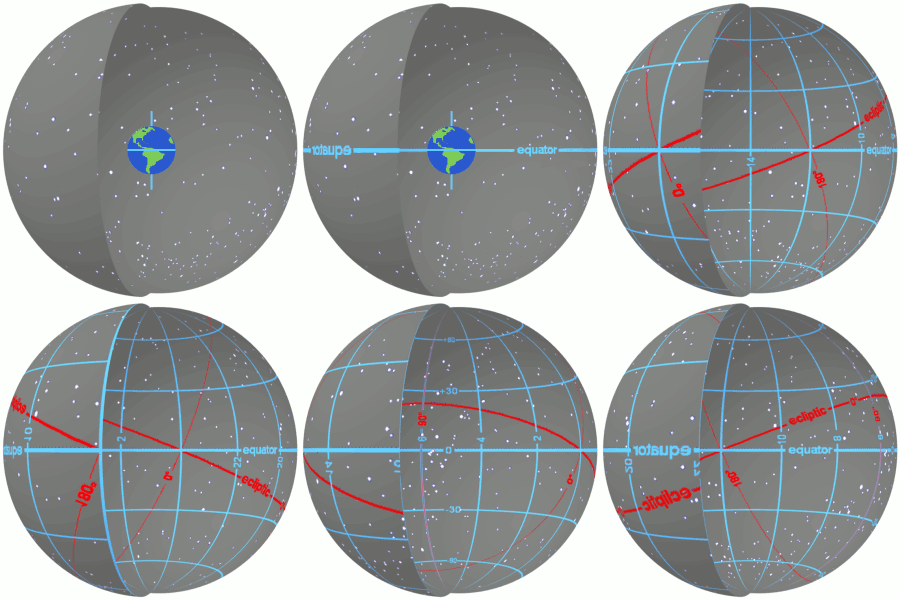
Right ascension is one half of the equatorial coordinate system, the other being declination. Imagine the celestial sphere as a giant, transparent ball with Earth at its center. The celestial equator is the projection of Earth's equator onto this sphere. RA measures the angle eastward along this celestial equator, starting from a reference point called the vernal equinox (also known as the First Point of Aries). This angle is typically expressed in hours, minutes, and seconds, where a full circle (360 degrees) is divided into 24 hours. Each hour of RA corresponds to 15 degrees. An object's hour circle is the great circle passing through the celestial poles and the object itself; RA is the angle between the vernal equinox's hour circle and the object's hour circle, measured eastward. This system allows astronomers to pinpoint any object in the sky with remarkable precision, akin to using latitude and longitude on Earth.
📊 Key Facts & Numbers
The celestial sphere, spanning 360 degrees, is divided into 24 hours of right ascension. Each hour is further subdivided into 60 minutes, and each minute into 60 seconds, totaling 86,400 seconds of RA for a full circle. The Sun's RA increases by approximately 360 degrees (or 24 hours) over the course of a year, moving eastward against the background stars. The brightest star in the night sky, Sirius, has a RA of approximately 6 hours, 45 minutes. The Andromeda Galaxy (M31) is located at RA 0 hours, 42 minutes. Modern sky surveys, like the Gaia mission, catalog the positions of over 1.8 billion stars, with RA being a primary coordinate for each. The International Astronomical Union (IAU) is responsible for standardizing astronomical coordinates, including RA, ensuring global consistency for over 100,000 cataloged celestial objects.
👥 Key People & Organizations
While RA is a coordinate system and not a person, its development involved numerous astronomers. Hipparchus (c. 190–120 BCE) is credited with creating one of the earliest star catalogs that implicitly used a coordinate system. Ptolemy (c. 100–170 CE) formalized this in his Almagest, establishing a grid on the celestial sphere. Later Islamic astronomers, such as Al-Battani (c. 858–929 CE), made significant contributions to observational astronomy and star cataloging, refining measurements. During the Renaissance, figures like Tycho Brahe (1546–1601) built highly accurate instruments, leading to more precise star positions. The modern understanding and application of RA were cemented by astronomers working with precise clocks and telescopes in the 18th and 19th centuries, including members of the Royal Astronomical Society. Organizations like the International Astronomical Union (IAU) continue to maintain and update the standards for RA and other astronomical coordinates.
🌍 Cultural Impact & Influence
Right ascension is the bedrock of observational astronomy and celestial navigation. It allows for the creation of star charts and catalogs that have guided sailors and explorers for centuries, and now guide telescopes and space probes. The concept of RA being measured in hours directly influenced the naming of constellations and the organization of astronomical data. It's a key component in understanding sidereal time, the 'star time' that governs the apparent motion of stars across the sky. The very act of mapping the universe, from nearby planets to the most distant galaxies, relies on RA and declination as its fundamental address system. This celestial grid has permeated popular culture through science fiction and astronomical imagery, making RA an invisible but ubiquitous element of our understanding of the cosmos.
⚡ Current State & Latest Developments
In 2024, right ascension remains an indispensable tool. The ongoing Gaia mission continues to release unprecedentedly precise astrometric data, including RA and declination, for billions of stars. The Vera C. Rubin Observatory's Legacy Survey of Space and Time (LSST) is mapping the sky with even greater detail, requiring robust RA calculations. The development of advanced algorithms for processing vast amounts of observational data, like those used by the Square Kilometre Array (SKA) project, relies heavily on accurate RA determination. Furthermore, the search for exoplanets and the study of transient astronomical events (like supernovae and gamma-ray bursts) depend on precisely knowing their RA to target observations and follow up in near real-time.
🤔 Controversies & Debates
While RA itself is a mathematical construct with universal agreement, its practical application can spark debate. The precise definition of the vernal equinox, the zero point for RA, can shift slightly over time due to precession of the equinoxes, requiring periodic updates to astronomical reference frames. Some astronomers debate the optimal units for RA; while hours are standard, a return to or greater emphasis on degrees for certain computational tasks is sometimes discussed. The sheer volume of data generated by modern surveys also presents challenges in cataloging and cross-referencing objects based on their RA, leading to ongoing development in astronomical databases and query systems. The historical evolution of RA measurements, from early naked-eye observations to modern CCD detectors, highlights the continuous refinement of accuracy, a process that never truly ends.
🔮 Future Outlook & Predictions
The future of right ascension is inextricably linked to advancements in observational technology and data processing. As telescopes become more sensitive and surveys cover larger portions of the sky with higher resolution, the precision of RA measurements will continue to increase. This will enable more detailed studies of galactic structure, the dynamics of star clusters, and the precise orbits of objects within our solar system and beyond. The development of artificial intelligence and machine learning will likely play a larger role in analyzing RA data, identifying patterns, and cataloging new celestial objects more efficiently. We can expect RA to remain a core component of astronomical databases and sky-mapping software for the foreseeable future, evolving with the instruments that measure it.
💡 Practical Applications
Right ascension is fundamental to numerous astronomical applications. It's used in celestial navigation to determine a ship's or aircraft's position using star sightings. In amateur astronomy, RA coordinates are essential for locating specific objects in the night sky with telescopes, often using setting circles or computerized mounts. Professional astronomers use RA to target observations with powerful telescopes like the Hubble Space Telescope and the James Webb Space Telescope. It's also critical for cataloging and studying exoplanets, quasars, and other deep-sky objects, enabling the creation of comprehensive astronomical databases like the SIMBAD Astronomical Database. Even in fields like astrophotography, understanding RA helps in planning long exposures and tracking celestial motion.
Key Facts
- Category
- science
- Type
- topic