
Contents
Overview
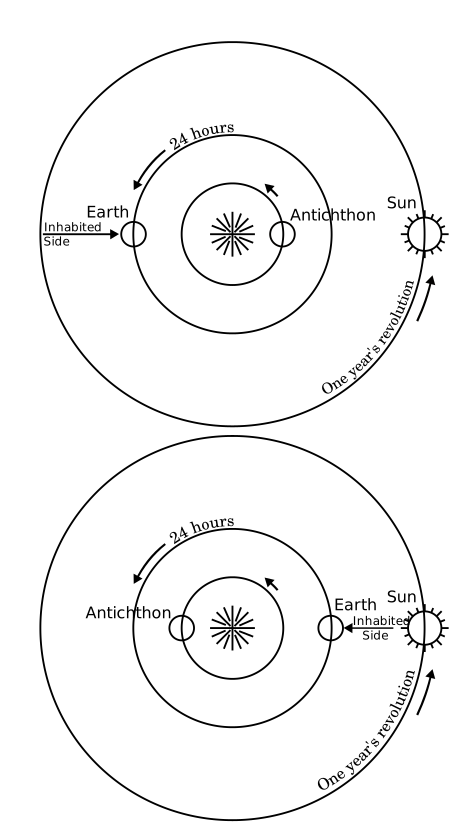
The Pythagorean system's origins are deeply intertwined with the philosophical and mathematical traditions of the Pythagorean school. While Pythagoras himself is not directly credited with this specific cosmological model, his followers, particularly Philolaus, are considered its architects. Philolaus, writing in the late 5th century BC, is believed to have articulated a system that moved Earth from the center of the cosmos, a revolutionary concept that predated Aristotle's influential geocentric model. This departure from traditional reasoning was not solely based on observation; it was also driven by a Pythagorean emphasis on numerical harmony and a desire for a more symmetrical universe, where the 'Central Fire' served as the hearth around which all bodies, including a hidden 'Counter-Earth,' orbited. The system's fragmented transmission through later writers like Aristotle and Plutarch makes precise reconstruction challenging, but its core innovation—de-centering Earth—is undeniable.
⚙️ How It Works
At its core, the Pythagorean system proposed a cosmos centered not on Earth, but on an unseen 'Central Fire.' This fiery nucleus was believed to be perpetually hidden from our view by the Earth's orbit and the existence of a 'Counter-Earth.' The system accounted for the five visible planets (Mercury, Venus, Mars, Jupiter, and Saturn), the Moon, and the Sun, all of which were thought to orbit this Central Fire in circular paths. Crucially, the system suggested that the apparent daily motion of the stars was not due to their movement, but rather to Earth's own rotation on its axis and its revolution around the Central Fire. This insight into the relativity of motion, anticipating later scientific developments, was a significant conceptual leap, even if the underlying mechanics, such as the necessity of a Counter-Earth to balance the number of celestial bodies to ten, were based on numerological rather than empirical grounds.
📊 Key Facts & Numbers
While precise numerical data from the Pythagorean system is scarce due to its fragmented nature, its conceptual scale is significant. The system posited a total of ten celestial bodies: the Central Fire, the Counter-Earth, the Moon, the Sun, and the five known planets. The number ten held mystical significance for the Pythagoreans, representing the tetractys (1+2+3+4=10), a sacred geometric figure. The system's departure from the traditional seven celestial spheres (Sun, Moon, five planets, and fixed stars) to include these additional, unseen entities was a radical conceptual expansion. It required Earth to travel approximately 365 days to complete one orbit around the Central Fire, a temporal scale that aligns with our modern understanding of an Earth year, though the reference point was entirely different.
👥 Key People & Organizations
The primary figures associated with the Pythagorean system are Philolaus of Croton and, by extension, the broader Pythagorean school. Philolaus, a 5th-century BC Pythagorean philosopher, is the most frequently cited proponent of this cosmological model, with his writings, though fragmentary, providing the most detailed accounts. Later philosophers and historians, including Aristotle in his work 'On the Heavens,' and Plutarch in 'On the Face in the Moon,' discussed and critiqued the Pythagorean system, preserving much of what we know about it. While not directly involved in its creation, these later commentators played a crucial role in transmitting and analyzing Philolaus's ideas, ensuring their survival through antiquity and into modern scholarship.
🌍 Cultural Impact & Influence
The Pythagorean system's influence, though indirect, is profound, particularly in its challenge to the long-held geocentric worldview. By proposing a non-central Earth, it laid conceptual groundwork that would resonate centuries later with the work of Copernicus and the heliocentric revolution. The idea that observed celestial motions could be explained by the observer's own movement was a critical conceptual shift, influencing later thinkers like Galileo Galilei in his understanding of relative motion. While the specific elements of the Pythagorean system, such as the Central Fire and Counter-Earth, were not adopted, its philosophical daring—to question the Earth's privileged position—marked a significant turning point in cosmological thought, demonstrating the power of abstract reasoning and numerical harmony to shape scientific inquiry.
⚡ Current State & Latest Developments
The Pythagorean system, as a specific cosmological model, is not actively 'developed' in the contemporary scientific sense. Its historical significance lies in its conceptual contributions rather than its ongoing scientific validity. Modern astronomy, based on centuries of observation and the laws of planetary motion established by Kepler and Newton, operates on a heliocentric framework with the Sun at the center of our solar system. However, the historical study of the Pythagorean system continues, with ongoing scholarly analysis of ancient texts and philosophical interpretations. The legacy of its ideas, particularly regarding the relativity of motion and the challenge to geocentrism, remains a vital part of the history of science, informing our understanding of how scientific ideas evolve.
🤔 Controversies & Debates
The primary controversy surrounding the Pythagorean system lies in the extent to which it was a scientific hypothesis versus a philosophical or mystical construct. Scholars debate whether Philolaus's model was intended as a literal description of the cosmos or as an allegorical representation of Pythagorean numerical and ethical principles. The inclusion of the 'Central Fire' and 'Counter-Earth,' entities not observable, suggests a strong mystical or numerological component, particularly the adherence to the number ten. Furthermore, the system's reliance on circular orbits was later found to be an oversimplification, as Kepler demonstrated that planets move in elliptical paths. The tension between its observational basis (acknowledging the five planets) and its abstract, possibly mythical, underpinnings is a persistent point of discussion.
🔮 Future Outlook & Predictions
The future outlook for the Pythagorean system is purely historical and philosophical. Its direct scientific relevance has long been superseded by more accurate models. However, its conceptual legacy continues to inform discussions about the nature of scientific progress and the interplay between observation, theory, and philosophical belief. Future scholarship may continue to refine our understanding of the textual evidence and the philosophical context of Pythagorean cosmology. The system serves as a perpetual reminder that even seemingly erroneous ancient ideas can contain profound conceptual seeds that influence the trajectory of scientific thought, demonstrating that the path to understanding the cosmos is rarely linear and often involves challenging deeply ingrained assumptions.
💡 Practical Applications
The Pythagorean system has no direct practical applications in modern technology or daily life. Its value is purely intellectual and historical. It serves as a case study in the history of science, illustrating early attempts to create systematic explanations for celestial phenomena. For astronomers and historians of science, it provides context for understanding the evolution of cosmological thought, highlighting the intellectual leaps made by ancient philosophers. It also offers a compelling example of how philosophical and mathematical principles can drive scientific inquiry, even when they lead to conclusions that are later proven incorrect. Its primary 'application' is in educating us about the long and winding road of human attempts to comprehend the universe.
Key Facts
- Category
- science
- Type
- topic