
Contents
Overview
The concept of pre-publication sharing of research findings has roots stretching back decades, predating the widespread internet. Early forms included informal circulation of manuscripts among colleagues and presentations at conferences. However, the modern preprint server truly began to take shape with the launch of arXiv. Initially focused on high-energy physics, arXiv provided a centralized, free, and accessible platform for physicists to share their work. This model proved so effective that it was later expanded to include other fields within physics, mathematics, computer science, and quantitative biology. The success of arXiv inspired the creation of similar platforms in other disciplines, such as bioRxiv and medRxiv by the Cold Spring Harbor Laboratory, catering specifically to the life and medical sciences, respectively. These platforms democratized access to cutting-edge research, bypassing the often lengthy publication cycles of traditional academic journals.
⚙️ How It Works
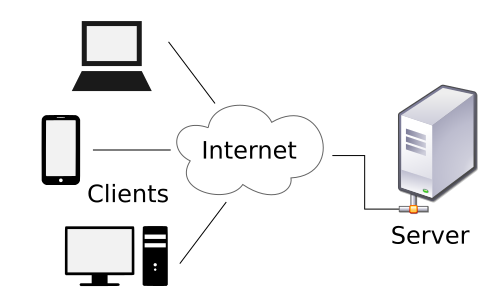
Preprint servers function as digital archives where researchers upload their manuscripts, typically in PDF format. Once submitted, the manuscripts undergo a basic screening process to ensure they are scientific in nature and adhere to ethical guidelines; this is not a peer-review process. After this initial check, usually completed within hours or a few days, the manuscript is made publicly available on the server. Authors retain copyright and can submit their work to traditional journals for formal peer review and publication concurrently or subsequently. The server itself acts as a timestamp, providing evidence of the date of discovery or conceptualization. Many servers also integrate with other scholarly infrastructure, such as ORCID for author identification and Crossref for digital object identifiers (DOIs), facilitating citation and tracking. The open access nature means anyone with an internet connection can read and download the papers, fostering rapid dissemination and discussion within the scientific community and beyond.
📊 Key Facts & Numbers
The impact of preprint servers on scientific output is substantial. Preprinted articles are cited more frequently and earlier than non-preprinted articles. arXiv is supported by Cornell University and the U.S. Department of Energy.
👥 Key People & Organizations
Several key individuals and organizations have been instrumental in the development and popularization of preprint servers. The Howard Hughes Medical Institute and the Wellcome Trust have provided crucial financial support for these initiatives, recognizing their value in accelerating scientific progress. The Center for Open Science (COS) also plays a significant role in promoting open science practices, including the use of preprints, through its OSF Preprints service and advocacy efforts. Many universities and research institutions now actively encourage their researchers to use preprint servers, further solidifying their place in the academic ecosystem.
🌍 Cultural Impact & Influence
Preprint servers have profoundly altered the landscape of scientific communication, fostering a culture of openness and rapid knowledge exchange. They have democratized access to research, breaking down traditional barriers imposed by journal subscriptions and lengthy review processes. This has particularly benefited researchers in institutions with limited resources and those in rapidly evolving fields where timely dissemination is critical. The ability to receive immediate feedback from a global community of peers, including those outside the traditional peer-review system, can help refine research and identify potential flaws or avenues for further investigation. Furthermore, preprints have become increasingly important during public health emergencies, as seen with COVID-19 research, where they allowed for swift sharing of critical findings on treatments, diagnostics, and vaccine development. This rapid sharing has also influenced media reporting, sometimes leading to premature or sensationalized coverage of preliminary findings, a point of significant cultural tension.
⚡ Current State & Latest Developments
The use of preprint servers has seen a dramatic surge in recent years, accelerated by the COVID-19 pandemic and a growing global movement towards open science. Many traditional journals are now actively encouraging or even requiring authors to post preprints before submission, recognizing their value. New preprint servers are emerging, covering specialized fields and interdisciplinary areas. Platforms like Research Square and Enago are offering preprint services alongside their other scholarly communication tools. There's also a growing integration of preprints with post-publication peer review platforms, such as PubPeer and Review Commons, creating a more dynamic and continuous evaluation process. The development of AI-powered tools to help researchers sift through the growing volume of preprints is also a significant current trend.
🤔 Controversies & Debates
The proliferation of preprint servers has ignited considerable debate within the scientific community. A primary concern is the potential for the dissemination of inaccurate, unverified, or even fraudulent research. Without the rigorous vetting of traditional peer review, preprints can be misinterpreted by other scientists, policymakers, journalists, and the public, leading to the spread of misinformation. Critics argue that preprints can confer an unwarranted sense of authority on preliminary findings, potentially influencing public health decisions or research directions prematurely. Conversely, proponents emphasize that preprints are clearly labeled as un-peer-reviewed and that the scientific process inherently involves self-correction and ongoing evaluation. They argue that the benefits of rapid dissemination and open feedback outweigh the risks, especially when coupled with responsible reporting and critical engagement. The question of whether preprints should be considered in academic hiring and promotion decisions remains a contentious issue, with some institutions embracing them and others hesitant.
🔮 Future Outlook & Predictions
The future of preprint servers appears to be one of continued integration and evolution within the scholarly ecosystem. We can expect to see further expansion into new disciplines and the development of more sophisticated tools for discovery and evaluation. The concept of 'overlay journals,' which curate preprints and then subject them to peer review, is gaining traction, offering a hybrid model.
Key Facts
- Category
- platforms
- Type
- topic