
Contents
Overview
A planetarium is a specialized theater designed to replicate the night sky and celestial phenomena, serving as a crucial tool for astronomical education and public engagement. Dominated by a large, hemispherical projection screen, these venues use sophisticated projectors to display stars, planets, and cosmic events with remarkable realism. From grand, permanent installations like the Hayden Planetarium in New York to portable, inflatable domes, planetariums cater to diverse audiences, offering immersive experiences that can simulate the sky from any location or time in history. They are not merely entertainment venues but vital educational institutions, fostering scientific curiosity and understanding of our universe. The technology has evolved dramatically, from early mechanical "star balls" to modern digital digital fulldome systems, pushing the boundaries of what can be shown and how interactively.
🎵 Origins & History
The concept of a planetarium traces its lineage back to ancient astronomical models, but the modern planetarium as a theatrical experience emerged in the early 20th century. The post-World War II era saw a significant expansion of planetarium construction, fueled by public interest in space exploration, particularly during the Space Race of the 1950s and 60s. Institutions like the Hayden Planetarium in New York and the Griffith Observatory in Los Angeles became iconic cultural landmarks.
⚙️ How It Works
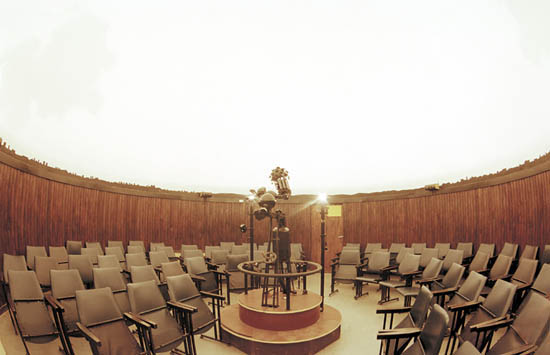
At its heart, a planetarium relies on a projector housed within a dome-shaped screen. Early projectors, known as "star balls," used a system of lenses and perforated metal spheres to project points of light representing stars. These mechanical marvels could simulate the apparent motion of celestial objects due to Earth's rotation and orbital path. Modern planetariums predominantly utilize digital projection systems, often employing multiple projectors to create a seamless, high-resolution image across the entire dome. These systems can render planets, nebulae, galaxies, and even complex astronomical simulations with stunning detail. Advanced software allows operators to control the projection, simulating the sky at any given time, from any location on Earth, and even from the surface of other planets or spacecraft. Some facilities also incorporate laser light shows and surround sound to enhance the immersive experience, transforming the dome into a dynamic canvas for cosmic exploration.
📊 Key Facts & Numbers
Annual attendance figures for major planetariums often exceed hundreds of thousands. The market for planetarium projectors and dome construction is a specialized niche. The International Planetarium Society (IPS) serves as a global professional organization, fostering collaboration and setting standards for planetarium professionals. Major institutions like the Adler Planetarium in Chicago and the Griffith Observatory in Los Angeles have been instrumental in public astronomical outreach for decades. More recently, organizations like the European Southern Observatory (ESO) have leveraged planetarium technology to disseminate their astronomical research findings to a wider audience.
👥 Key People & Organizations
Key figures in the development of planetariums include Walther Bauersfeld, the chief engineer at Carl Zeiss AG who designed the first optical-mechanical projector. Armand Spitz, an American inventor, developed a more affordable "star projector" in the late 1940s, significantly increasing the accessibility of planetariums for smaller institutions. The International Planetarium Society (IPS) serves as a global professional organization, fostering collaboration and setting standards for planetarium professionals. Major institutions like the Adler Planetarium in Chicago and the Griffith Observatory in Los Angeles have been instrumental in public astronomical outreach for decades. More recently, organizations like the European Southern Observatory (ESO) have leveraged planetarium technology to disseminate their astronomical research findings to a wider audience.
🌍 Cultural Impact & Influence
Planetariums have profoundly shaped public perception and understanding of astronomy and space exploration. They offer a unique, visceral connection to the cosmos, transforming abstract scientific concepts into awe-inspiring visual spectacles. For many, a childhood visit to a planetarium sparks a lifelong passion for science, influencing career choices and fostering scientific literacy. Beyond education, planetariums have become cultural hubs, hosting events ranging from concerts and art installations to lectures by renowned scientists like Neil deGrasse Tyson. The immersive nature of dome projection has also influenced other media, inspiring filmmakers and game developers to explore panoramic and virtual reality experiences. The ability to visualize complex phenomena, such as the formation of galaxies or the orbits of exoplanets, makes planetariums invaluable for communicating cutting-edge scientific discoveries.
⚡ Current State & Latest Developments
The current state of planetariums is characterized by a rapid shift towards fully digital, high-resolution projection systems. There's also a growing trend towards interactive planetarium shows, where audiences can influence the narrative or explore virtual environments in real-time, often facilitated by virtual reality and augmented reality integration. The Association of Science and Technology Centers (ASTC) reports a steady interest in planetarium programming, indicating continued relevance. Furthermore, the development of cloud-based content libraries allows for easier sharing and access to new shows and educational materials among planetariums worldwide.
🤔 Controversies & Debates
One persistent debate revolves around the balance between scientific accuracy and entertainment value in planetarium shows. Critics sometimes argue that overly dramatized or simplified narratives can lead to misconceptions about astronomical phenomena. For instance, the depiction of the sky's appearance can be simplified for narrative flow, potentially omitting nuances of atmospheric effects or observational challenges. Another area of contention is the cost-effectiveness of maintaining and upgrading these complex facilities, especially for smaller institutions with limited budgets. The rise of accessible VR headsets and high-quality online astronomical content also presents a challenge, raising questions about whether the traditional planetarium model can compete with more personalized, on-demand experiences. Some also debate the pedagogical effectiveness of passive dome viewing versus more interactive learning methods.
🔮 Future Outlook & Predictions
The future of planetariums is inextricably linked to advancements in digital projection, AI, and immersive technologies. We can expect to see increasingly sophisticated simulations, potentially incorporating real-time data from space telescopes like the James Webb Space Telescope. AI could personalize show content based on audience demographics or specific learning objectives, creating truly bespoke astronomical journeys. The integration of VR and AR will likely blur the lines between the physical planetarium dome and digital exploration, allowing viewers to "step out" of the dome and into virtual celestial environments. There's also potential for planetariums to become more dynamic research hubs, using their projection capabilities for data visualization in fields beyond astronomy, such as climate science or urban planning. The development of more affordable, modular dome systems could also democratize access, bringing immersive cosmic experiences to even more communities.
💡 Practical Applications
Planetariums serve a multitude of practical applications beyo
Key Facts
- Category
- aesthetics
- Type
- topic