
Contents
Overview
The inquiry into existence predates formal philosophical categorization, with early seeds sown in the pre-Socratic era of ancient Greek philosophy. Thinkers like Parmenides (c. 5th century BCE) asserted that 'what is, is, and what is not, cannot be.' His contemporary Zeno of Elea developed paradoxes to defend Parmenides' view, challenging notions of motion and plurality. Later, Plato distinguished between the eternal, perfect Forms and the transient, imperfect physical world, suggesting different modes of reality. Aristotle, in his Metaphysics, systematically explored 'being qua being,' categorizing existence and positing a 'Prime Mover' as the ultimate source of existence. Medieval philosophers like Thomas Aquinas synthesized Aristotelian thought with theology, exploring the existence of God and the distinction between essence and existence. The modern era saw René Descartes' foundational 'Cogito, ergo sum' ('I think, therefore I am'), placing conscious existence at the forefront, while Immanuel Kant argued that existence is not a predicate and cannot be logically deduced, profoundly influencing subsequent debates.
⚙️ How It Works
At its core, the philosophy of existence operates through conceptual analysis and logical argumentation. Philosophers examine the meaning of 'is,' 'exists,' and 'being' by dissecting propositions and exploring their logical implications. Key distinctions are drawn: existence versus essence (what a thing is vs. that it is), concrete existence (physical objects) versus abstract existence (numbers, concepts), and necessary existence (true in all possible worlds) versus contingent existence (true in some possible worlds). The field often employs thought experiments, such as Gödels incompleteness theorems' implications for formal systems or simulated reality hypotheses, to probe the boundaries of what we consider real. The methodology involves rigorous definition, identification of logical contradictions, and the construction of coherent metaphysical frameworks. It’s less about empirical discovery and more about the architecture of reality as understood through reason.
📊 Key Facts & Numbers
The concept of existence is fundamental, yet its quantification is elusive. However, we can note its pervasive influence: The concept of 'null' or 'undefined' represents a state akin to non-existence within a system, a notion explored in programming languages since the 1960s. The global philosophical literature on existence spans thousands of academic journals and tens of thousands of books published annually, indicating a persistent intellectual engagement.
👥 Key People & Organizations
Key figures in the philosophy of existence include Parmenides, who posited a singular, unchanging Being; Plato, with his theory of Forms; Aristotle, who systematically analyzed 'being qua being'; René Descartes, whose 'Cogito' centered existence on consciousness; and Immanuel Kant, who challenged the predicate status of existence. In the 20th century, Martin Heidegger profoundly explored the question of Being (Sein) and human existence (Dasein). Jean-Paul Sartre further popularized existentialist themes, emphasizing radical freedom and responsibility in a meaningless universe. Organizations like the American Philosophical Association and the Royal Institute of Philosophy host numerous conferences and publish journals dedicated to these fundamental questions, fostering ongoing discourse among scholars worldwide.
🌍 Cultural Impact & Influence
The philosophy of existence has permeated Western thought and culture, shaping everything from literature and art to psychology and theology. The existentialist movement, heavily influenced by these ideas, produced iconic works like Albert Camus' The Stranger and Franz Kafka's The Metamorphosis, exploring themes of alienation, absurdity, and the search for meaning in a seemingly indifferent universe. The concept of 'being' is central to theological discussions about the nature of God, as seen in the works of Augustine of Hippo and Thomas Aquinas. In psychology, existential psychology draws directly from these philosophical tenets to address anxiety, freedom, and the search for meaning in therapeutic contexts. The enduring popularity of films like The Matrix, which questions the nature of perceived reality, demonstrates the continued cultural resonance of these philosophical inquiries.
⚡ Current State & Latest Developments
Contemporary discussions engage with advancements in artificial intelligence and consciousness studies, asking whether AI can truly 'exist' or possess consciousness. Debates around simulation hypothesis continue to gain traction, fueled by computational power and philosophical arguments. Researchers are also exploring the implications of quantum mechanics for our understanding of reality, with some interpretations suggesting observer-dependent existence. The rise of transhumanism also poses new questions about the future of human existence and what it means to be 'human' in an era of rapid technological augmentation. The philosophical exploration of existence is not static; it evolves with our scientific understanding and technological capabilities.
🤔 Controversies & Debates
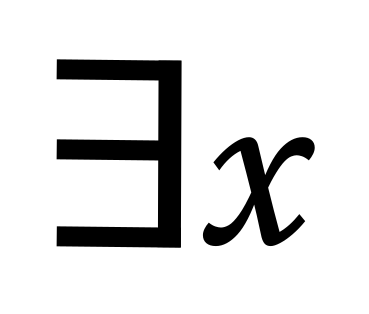
One of the most enduring controversies is the nature of abstract objects: do numbers, sets, or universals exist independently of our minds, or are they merely conceptual tools? This is the debate between Platonism (realism about abstract objects) and nominalism (denial of abstract objects). Another major debate concerns the existence of free will versus determinism; if all events are causally determined, can our choices truly be said to originate from our existence? Martin Heidegger's complex and often opaque writings on 'Being' have also been a source of significant debate and interpretation, with critics questioning the coherence and utility of his concepts. Furthermore, the very definition of 'existence' is contested: is it a property, a logical operator, or something else entirely? Philosophers like W.V.O. Quine famously argued 'to be is to be the value of a bound variable,' a position that itself faces considerable opposition.
🔮 Future Outlook & Predictions
The future of existence philosophy will likely be shaped by advancements in neuroscience and artificial intelligence. As we develop more sophisticated AI, the question of machine consciousness and existence will become increasingly pressing. Will AI achieve genuine sentience, and if so, what ethical and ontological implications will that have? The exploration of multiverse theories in physics may also lead to new philosophical frameworks for understanding existence across potentially infinite realities. Furthermore, the ongoing dialogue between philosophy and the sciences, particularly in areas like quantum physics and cosmology, promises to refine our understanding of the fundamental constituents of reality. We may see a greater integration of empirical findings into metaphysical speculation, moving beyond purely a priori reasoning. The
Key Facts
- Category
- philosophy
- Type
- topic