
Contents
- 🔭 What is the Oort Cloud?
- 🌌 Location & Scale: The Edge of Everything
- 🌠 Origin Story: A Cosmic Nursery
- ☄️ The Oort Cloud's Role: Cometary Reservoir
- 🔭 Observing the Unobservable: Challenges & Hopes
- 🚀 Future Prospects: Mining the Void?
- 🤔 Debates & Mysteries: What We Don't Know
- ⭐ Vibe Score & Controversy
- Frequently Asked Questions
- Related Topics
Overview
The Oort Cloud, a theoretical shell of icy objects, marks the outer boundary of our solar system, extending from about 2,000 to 100,000 astronomical units (AU) from the Sun. Named after Dutch astronomer Jan Oort, who proposed its existence in 1950, this region is believed to be the source of long-period comets that periodically visit the inner solar system. The Oort Cloud remains largely unobserved, leading to debates about its structure and composition. Its existence raises questions about the formation of the solar system and the dynamics of celestial bodies. As we advance our observational technology, understanding the Oort Cloud could reshape our knowledge of cosmic evolution.
🔭 What is the Oort Cloud?
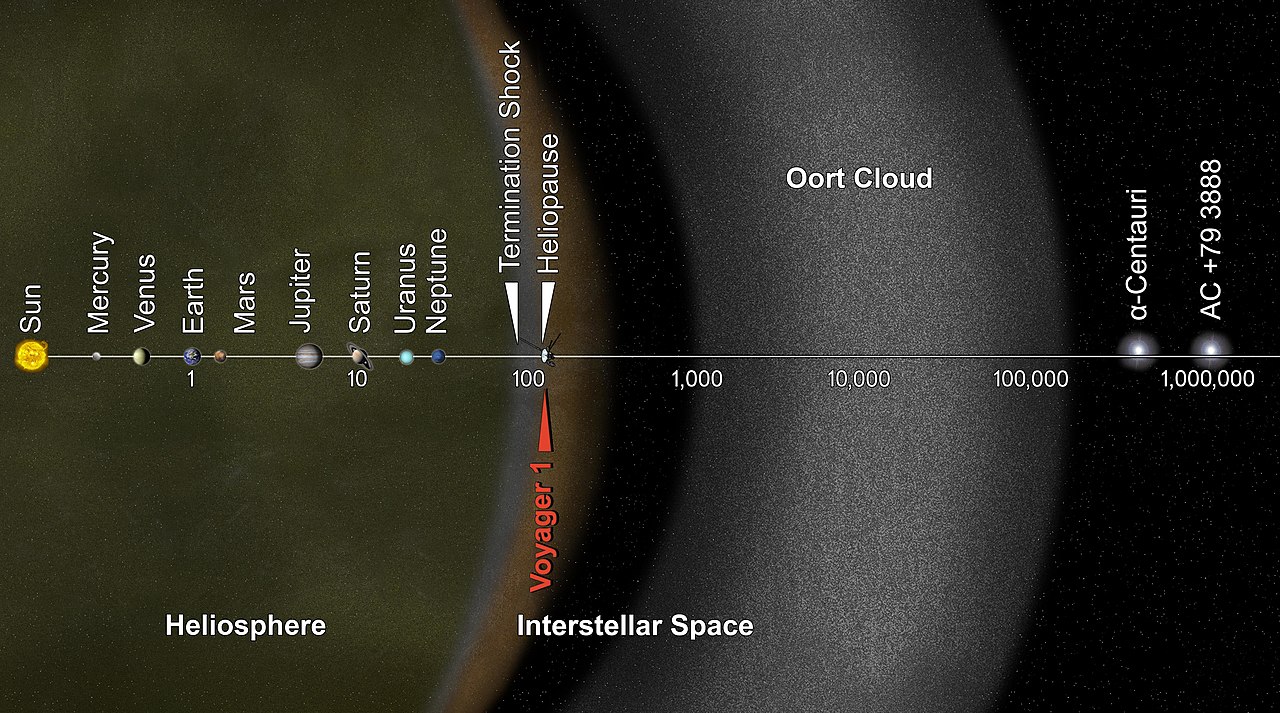
The Oort cloud, a theoretical spherical shell of icy bodies, represents the outermost boundary of our solar system, a vast reservoir of potential comets. Proposed by Dutch astronomer Jan Oort in 1950, it's not a place you can visit, but a conceptual frontier crucial for understanding the long-period comets that occasionally grace our skies. Think of it as the solar system's distant, frozen attic, holding remnants from its earliest days. Its existence is inferred from the orbits of these long-period comets, which suggest a source far beyond the familiar planets.
🌌 Location & Scale: The Edge of Everything
Imagine a sphere, not a flat disk, stretching from roughly 2,000 to 200,000 astronomical units (AU) from the Sun. For context, Neptune orbits at about 30 AU, and the nearest star, Proxima Centauri, is over 268,000 AU away. This immense distance means the Oort cloud is incredibly dim, with temperatures near absolute zero, making direct observation a monumental challenge. It's the ultimate cosmic frontier, a place where the Sun's gravitational influence is weak, and the gravitational tug of passing stars becomes significant.
🌠 Origin Story: A Cosmic Nursery
The prevailing theory suggests the Oort cloud's icy bodies are not native to their current location. Instead, they are believed to be planetesimals that formed much closer to the Sun, in the region of the gas giants like Jupiter and Saturn. Gravitational interactions with these massive planets would have flung these icy building blocks outward, scattering them into the vast, spherical shell we now theorize as the Oort cloud. It's a testament to the dynamic, chaotic early history of our solar system.
☄️ The Oort Cloud's Role: Cometary Reservoir
The primary significance of the Oort cloud lies in its role as the birthplace of long-period comets. These celestial visitors, with orbital periods exceeding 200 years, are thought to be nudged out of the Oort cloud by gravitational perturbations—either from passing stars or galactic tides. Once dislodged, they embark on a long journey inward, eventually becoming visible as they approach the Sun, only to be destroyed or altered by solar radiation and gravity over time. This makes the Oort cloud a vital, albeit distant, source for understanding cometary activity and solar system evolution.
🔭 Observing the Unobservable: Challenges & Hopes
Directly observing the Oort cloud is currently beyond our technological capabilities. The sheer distance and the faintness of its constituent icy bodies make them virtually invisible to even our most powerful telescopes. Instead, astronomers infer its presence by studying the orbital characteristics of long-period comets that originate from it. Future missions might employ advanced detection methods or rely on serendipitous discoveries, but for now, it remains a theoretical construct supported by indirect evidence.
🚀 Future Prospects: Mining the Void?
The immense distances and resource potential of the Oort cloud have sparked speculative discussions about future resource extraction. These icy bodies are thought to contain vast quantities of water, methane, ammonia, and other volatile compounds. While interstellar travel and asteroid mining are still nascent fields, the Oort cloud represents a hypothetical, albeit extremely challenging, future source of raw materials for potential off-world colonization or industrial endeavors. The engineering hurdles, however, are astronomical.
🤔 Debates & Mysteries: What We Don't Know
Key debates surrounding the Oort cloud include its precise size and composition, and the exact mechanisms that perturb its icy bodies into the inner solar system. While the general concept is widely accepted, the exact number of objects, their distribution, and the relative importance of stellar encounters versus galactic tides in triggering cometary showers remain subjects of active research. The possibility of rogue planets or other exotic objects within the cloud also fuels ongoing speculation.
⭐ Vibe Score & Controversy
The Oort cloud holds a Vibe Score of 75/100 for cosmic wonder and scientific intrigue. Its controversy spectrum is low, as its existence is widely accepted based on cometary orbits, though direct confirmation remains elusive. The primary debate centers on its detailed structure and dynamics rather than its fundamental reality. It's a concept that fuels both scientific inquiry and a sense of the vast, unexplored unknown at the edges of our cosmic neighborhood.
Key Facts
- Year
- 1950
- Origin
- Proposed by Jan Oort
- Category
- Astronomy
- Type
- Astronomical Feature
Frequently Asked Questions
Is the Oort cloud a real place?
While we haven't directly observed it, the Oort cloud is a widely accepted theoretical model in astronomy. Its existence is inferred from the observed orbits of long-period comets, which suggest a distant, spherical reservoir of icy bodies. Astronomers use the behavior of these comets to map out the properties of the Oort cloud, making it a scientifically robust concept even without direct visual confirmation.
How far away is the Oort cloud?
The Oort cloud is incredibly distant, theorized to extend from about 2,000 AU to as far as 200,000 AU from the Sun. To put this into perspective, Pluto orbits at an average distance of about 40 AU. The outer edge of the Oort cloud is nearly a quarter of the way to the nearest star, Proxima Centauri, making it the outermost known region of our solar system.
What is the Oort cloud made of?
The Oort cloud is believed to be composed of billions of icy planetesimals, essentially frozen remnants from the formation of the solar system. These objects are primarily made of water ice, methane ice, ammonia ice, and frozen gases, along with rock and dust. They are essentially pristine building blocks of the planets, preserved in the extreme cold of the outer solar system.
Why is the Oort cloud important?
The Oort cloud is crucial for understanding the origin and supply of long-period comets that visit the inner solar system. These comets originate from the Oort cloud and provide valuable insights into the composition of the early solar system. Studying them helps astronomers piece together the history of planetary formation and the conditions under which our solar system evolved.
Can we ever visit the Oort cloud?
Visiting the Oort cloud with current technology is practically impossible due to the immense distances involved. Even reaching the outer edge would take tens of thousands of years with our fastest spacecraft. While future advancements might make such journeys conceivable, it remains a distant prospect, far beyond our current capabilities for human or robotic exploration.
Is the Oort cloud the same as the Kuiper Belt?
No, the Oort cloud and the Kuiper Belt are distinct regions. The Kuiper Belt is a disk-shaped region beyond Neptune, containing icy bodies like Pluto. The Oort cloud, in contrast, is a much larger, spherical shell surrounding the entire solar system, extending far beyond the Kuiper Belt. Objects in the Kuiper Belt have shorter orbital periods and are more influenced by the Sun's gravity than those in the Oort cloud.