
Contents
Overview
Nuclear propulsion encompasses a diverse range of technologies that utilize nuclear reactions as their primary energy source for generating thrust. While most famously embodied by the nuclear reactors powering naval vessels like aircraft carriers and submarines, enabling extended operational periods without refueling, its potential extends far beyond Earth's oceans. In the realm of space exploration, nuclear thermal and nuclear electric propulsion systems offer significantly higher efficiencies compared to conventional chemical rockets, promising faster transit times and greater payload capacities for deep-space missions. The conceptual roots of nuclear propulsion stretch back to the early 20th century, with early hypotheses in 1903 suggesting radioactive elements like radium could fuel vehicles. This futuristic vision was later amplified by science fiction, notably H.G. Wells's 1914 novel, 'The World Set Free,' which envisioned a world transformed by atomic power, including its application in propulsion. Today, while naval applications are mature, space-based nuclear propulsion remains a critical area of research and development, holding the key to humanity's ambitious interplanetary and interstellar aspirations.
🎵 Origins & History
The genesis of nuclear propulsion can be traced to the dawn of the atomic age. As early as 1903, scientists speculated about the potential of radioactive materials, such as radium, to serve as potent fuel sources for vehicles, envisioning cars, planes, and boats powered by atomic energy. This nascent idea captured the public imagination, notably appearing in H.G. Wells's 1914 novel, The World Set Free, which depicted a future where atomic power, including its application in propulsion, reshaped society. The practical realization of this concept began in earnest during the Cold War, driven by military imperatives. The first nuclear-powered submarine, the USS Nautilus, launched in 1954 and commissioned in 1955, marked a monumental leap, demonstrating sustained underwater operations previously unimaginable. This naval success paved the way for nuclear-powered aircraft carriers, with the USS Enterprise becoming the world's first in 1961, showcasing the immense power and endurance nuclear reactors could provide.
⚙️ How It Works
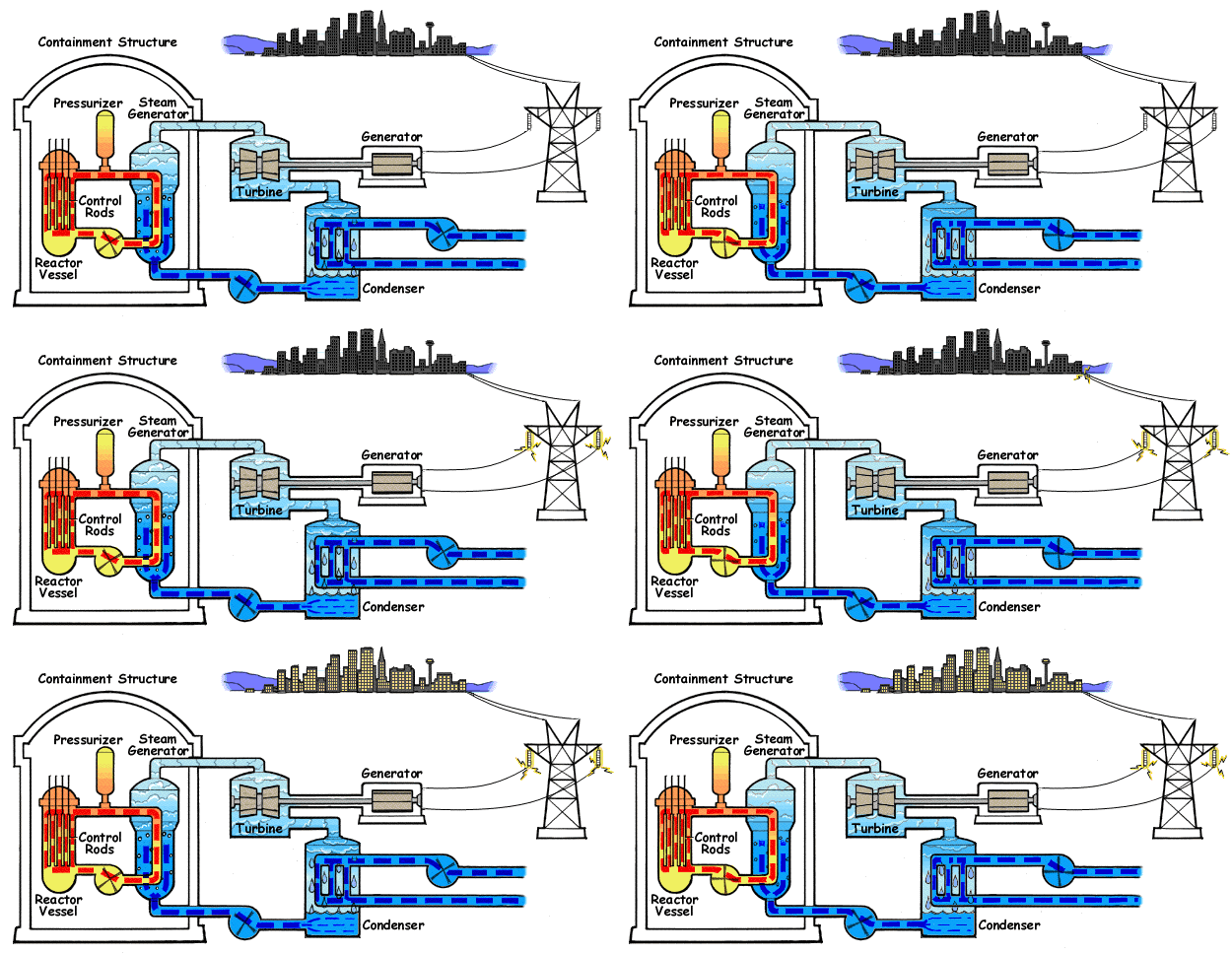
At its core, nuclear propulsion relies on controlled nuclear reactions to generate immense heat, which is then converted into mechanical energy for thrust. The most common implementation, particularly in naval vessels, involves fission reactors. Here, heavy atomic nuclei, typically uranium-235 or plutonium-239, are split in a controlled chain reaction within the reactor core. This fission process releases a tremendous amount of thermal energy. This heat is used to boil water, producing high-pressure steam that drives turbines. These turbines, in turn, power generators for electrical systems and directly drive propulsion shafts connected to propellers or water jets. For space applications, nuclear thermal propulsion (NTP) heats a propellant, such as liquid hydrogen, to extremely high temperatures using a nuclear reactor, expelling it through a nozzle for thrust. Nuclear electric propulsion (NEP) uses a reactor to generate electricity, which then powers electric thrusters like ion thrusters or Hall-effect thrusters, offering high specific impulse but lower thrust.
📊 Key Facts & Numbers
Naval nuclear propulsion has achieved remarkable feats: the USS Nautilus could operate submerged for months, covering over 62,000 nautical miles on its initial core load. The United States Navy currently operates over 70 nuclear-powered submarines and 11 aircraft carriers, with each carrier's reactors capable of generating hundreds of megawatts of thermal power. These reactors typically refuel only once every 25-30 years. In space, nuclear thermal rockets promise specific impulses of up to 900 seconds, nearly double that of the most advanced chemical rockets, which typically achieve around 450 seconds. A single kilogram of uranium fuel can release energy equivalent to burning 3 million kilograms of coal. The proposed nuclear-electric propulsion systems for missions to Mars could reduce transit times from 6-9 months to as little as 3-4 months, significantly mitigating astronaut exposure to deep-space radiation.
👥 Key People & Organizations
Key figures in the development of nuclear propulsion include Admiral Hyman G. Rickover, often called the "Father of the Nuclear Navy," who spearheaded the development of the USS Nautilus and championed nuclear power for naval applications. Scientists like Enrico Fermi, who led the team that achieved the first self-sustaining nuclear chain reaction in 1942 at the University of Chicago's Chicago Pile-1, laid the fundamental groundwork. In the space sector, organizations like NASA and the Department of Energy have been instrumental. Projects like NERVA (Nuclear Engine for Rocket Vehicle Application) in the 1960s and 70s, managed by NASA and the U.S. Air Force, explored nuclear thermal propulsion. More recently, companies like Blue Origin and SpaceX have expressed interest in advanced propulsion, including nuclear concepts for future space exploration.
🌍 Cultural Impact & Influence
Nuclear propulsion has profoundly shaped naval strategy and capability, granting submarines unprecedented stealth and endurance, and enabling aircraft carriers to maintain persistent global presence. The iconic image of a nuclear-powered submarine silently patrolling the depths or an aircraft carrier steaming across oceans has become synonymous with superpower projection. In popular culture, nuclear-powered spacecraft have long been a staple of science fiction, from Star Trek's warp drives (often conceptually linked to advanced energy sources) to the more literal depictions of nuclear rockets in various space operas. These fictional portrayals have both fueled public fascination with atomic power and contributed to anxieties surrounding nuclear technology, reflecting a complex societal relationship with its potential and perils. The very idea of rapid interplanetary travel, as depicted in films like The Martian (which featured a hypothetical nuclear-powered ascent vehicle), is largely dependent on the promise of nuclear propulsion.
⚡ Current State & Latest Developments
The current landscape of nuclear propulsion is bifurcated: naval applications are mature and widespread, while space applications are in various stages of development and testing. The U.S. Navy continues to modernize its fleet, with new Columbia-class submarines and Ford-class aircraft carriers incorporating advanced reactor designs. For space, NASA is actively pursuing nuclear thermal propulsion through initiatives like the Demonstration Rocket for Agile Cislunar Operations (DRACO) program, a joint effort with DARPA, aiming for a flight demonstration by 2027. This program utilizes a Saf-400 reactor design. Russia has also continued its development of nuclear space propulsion, notably with its Transport and Energy Module (TEM) project, intended for deep-space missions. Private companies are also entering the fray, with General Atomics developing compact reactors for potential space applications, and Intuitive Machines exploring lunar power systems.
🤔 Controversies & Debates
The primary controversies surrounding nuclear propulsion revolve around safety, proliferation, and environmental concerns. For naval applications, the risk of accidents, though statistically low, carries catastrophic potential, particularly concerning the disposal of spent nuclear fuel and the decommissioning of aging reactors. The potential for nuclear materials to be diverted for weapons purposes, or the risk of reactors falling into the wrong hands, remains a persistent security concern, especially in geopolitical hotspots. In space, while the benefits of faster transit times are clear, the prospect of launching nuclear reactors into orbit raises fears of catastrophic failures during launch or re-entry, potentially dispersing radioactive material. Public perception, often shaped by historical events like the Chernobyl disaster and the Fukushima Daiichi nuclear disaster, fuels significant public apprehension, making widespread adoption challenging. Debates persist over the acceptable level of risk for both terrestrial and extraterrestrial applications.
🔮 Future Outlook & Predictions
The future of nuclear propulsion, particularly in space, appears increasingly promising as technological hurdles are overcome and the demand for faster, more efficient deep-space travel grows. NASA's DRACO program is a significant step towards demonstrating NTP's viability, potentially paving the way for crewed missions to Mars and beyond. Experts predict that within the next two decades, nuclear the
💡 Practical Applications
Nuclear propulsion offers a powerful solution for various applications. In naval operations, it enables submarines and aircraft carriers to operate for extended periods without refueling, providing unparalleled endurance and strategic flexibility. For space exploration, nuclear thermal and nuclear electric propulsion systems promise significantly higher efficiencies than conventional chemical rockets. This translates to faster transit times for deep-space missions, allowing for quicker journeys to destinations like Mars and the outer planets, and enabling larger payloads to be carried. The potential for rapid interplanetary travel is a key driver for continued research and development in this field.
Key Facts
- Category
- technology
- Type
- topic