
Contents
- 🎵 Origins & History
- ⚙️ How It Works
- 📊 Key Facts & Numbers
- 👥 Key People & Organizations
- 🌍 Cultural Impact & Influence
- ⚡ Current State & Latest Developments
- 🤔 Controversies & Debates
- 🔮 Future Outlook & Predictions
- 💡 Practical Applications
- 📚 Related Topics & Deeper Reading
- Frequently Asked Questions
- References
- Related Topics
Overview
The formalization of normed vector spaces emerged from the desire to extend calculus and analysis to infinite-dimensional settings, a pursuit that gained significant traction in the early 20th century. Precursors can be found in the work of mathematicians like David Hilbert and his studies on integral equations, which hinted at the need for spaces with well-defined 'size' properties. The concept was significantly advanced by Stefan Banach in the 1920s, who introduced the notion of a complete normed vector space, now known as a Banach space. His seminal 1932 book, 'Théorie des opérations linéaires' (Theory of Linear Operations), laid much of the groundwork for functional analysis, solidifying the importance of normed spaces. Early applications were found in quantum mechanics, where states are represented by vectors in Hilbert spaces, a special type of normed space.
⚙️ How It Works
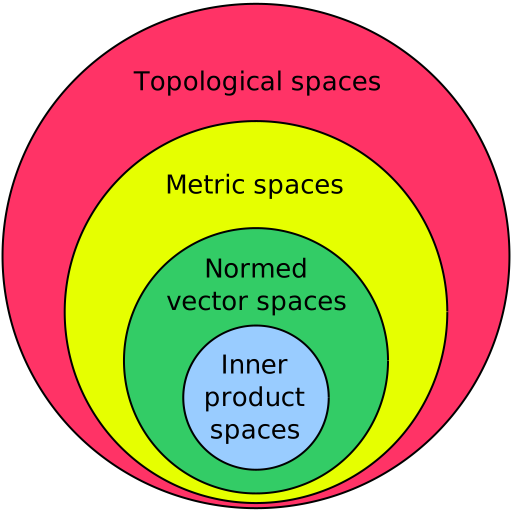
At its core, a normed vector space is a vector space V over a field K (typically ℝ or ℂ) endowed with a norm function, denoted as ‖⋅‖. This norm maps each vector v in V to a non-negative real number, ‖v‖, representing its 'length' or 'magnitude'. For a function to be a valid norm, it must satisfy three axioms: non-negativity (‖v‖ ≥ 0, and ‖v‖ = 0 if and only if v is the zero vector), absolute homogeneity (‖αv‖ = |α|‖v‖ for any scalar α), and the triangle inequality (‖u + v‖ ≤ ‖u‖ + ‖v‖ for any vectors u, v). This structure allows for the definition of a metric (distance) d(u, v) = ‖u - v‖, turning the vector space into a metric space and enabling concepts like convergence and continuity.
📊 Key Facts & Numbers
The ubiquity of normed spaces is underscored by their prevalence in various mathematical and scientific domains. For instance, the Euclidean space ℝⁿ, equipped with the standard Euclidean norm ‖x‖₂ = (∑ᵢ |xᵢ|²)^(1/2), is a fundamental example. The space of continuous functions on a closed interval [a, b], denoted C[a, b], equipped with the supremum norm ‖f‖∞ = supₓ∈[a,b] |f(x)|, is a Banach space with infinitely many dimensions. The space of square-integrable functions L²([a, b]) has a norm ‖f‖₂ = (∫[a,b] |f(x)|² dx)^(1/2), which is crucial in quantum mechanics and signal processing. The dimension of these spaces can range from finite (like ℝⁿ) to countably infinite or even uncountably infinite.
👥 Key People & Organizations
Several mathematicians are pivotal to the development and understanding of normed vector spaces. Stefan Banach (1892-1945) is arguably the most central figure, whose work on linear operations and the introduction of complete normed spaces (Banach spaces) defined the field of functional analysis. David Hilbert (1862-1943) laid crucial groundwork with his studies on integral equations and the Hilbert spaces, which are complete inner product spaces, a special subclass of Banach spaces. John von Neumann (1903-1957) made significant contributions to the theory of Hilbert spaces and their applications in quantum mechanics and operator theory. Contemporary researchers continue to explore properties and applications of various normed spaces in fields ranging from pure mathematics to applied sciences.
🌍 Cultural Impact & Influence
Normed vector spaces have profoundly influenced the trajectory of modern mathematics and physics. The ability to rigorously define 'distance' and 'convergence' in abstract settings, particularly in infinite dimensions, opened up new avenues for theoretical development. In physics, quantum mechanics relies heavily on Hilbert spaces, where vectors represent quantum states and operators represent physical observables, with norms dictating probabilities. In computer science, particularly in machine learning and data science, norms are used extensively for regularization (e.g., L1 and L2 regularization in deep learning models) to prevent overfitting and improve generalization. The development of signal processing algorithms also heavily depends on the analysis of functions in normed spaces like L².
⚡ Current State & Latest Developments
The study of normed vector spaces remains an active area of research, with ongoing efforts to understand their structure, classification, and applications. Current developments focus on exploring new classes of normed spaces, investigating their topological and geometric properties, and extending their use in emerging fields. For instance, research into non-Archimedean normed spaces and their applications in number theory and p-adic analysis continues. In applied mathematics, there's a continuous push to develop more efficient numerical methods for solving problems in high-dimensional normed spaces, particularly relevant for large-scale simulations in physics and engineering. The integration of normed space concepts into advanced AI architectures is also a growing trend.
🤔 Controversies & Debates
While the mathematical framework of normed vector spaces is well-established, debates can arise regarding the most effective or generalizable norms for specific applications. For example, in machine learning, the choice between L1 (Lasso) and L2 (Ridge) regularization, both norms, can significantly impact model performance and interpretability, leading to ongoing discussions about which norm is 'best' for a given task. Furthermore, the computational complexity of working with certain infinite-dimensional normed spaces can be a practical challenge, prompting research into approximations and efficient algorithms. The theoretical implications of different norm choices in areas like optimal transport also present fertile ground for mathematical debate.
🔮 Future Outlook & Predictions
The future of normed vector spaces appears intrinsically linked to the advancement of fields that rely on abstract mathematical structures. As scientific inquiry pushes into more complex and high-dimensional domains, the need for robust analytical tools provided by normed spaces will only increase. We can anticipate further integration of these concepts into cutting-edge AI and data science applications, potentially leading to new forms of data analysis and predictive modeling. In theoretical physics, the exploration of quantum gravity and other fundamental theories may necessitate the development of novel normed space structures. The ongoing quest for more efficient numerical methods will also continue to drive innovation in how we compute and approximate solutions within these spaces.
💡 Practical Applications
Normed vector spaces are not merely abstract mathematical curiosities; they are workhorses in numerous practical applications. In signal processing, they are used to analyze and manipulate signals, such as audio or image data, by treating them as vectors in function spaces. Machine learning algorithms frequently employ norms for feature selection, dimensionality reduction, and model regularization, with L1 and L2 norms being standard tools. Quantum mechanics uses Hilbert spaces (a type of complete normed space) to describe the states of quantum systems and the evolution of these states over time. Computer vision utilizes norms for tasks like image comparison and feature matching. Even in economics, concepts related to norms appear in utility theory and optimization problems.
Key Facts
- Year
- Early 20th Century
- Origin
- Poland / Germany / France (Conceptual development across multiple European centers)
- Category
- science
- Type
- concept
Frequently Asked Questions
What is the most basic example of a normed vector space?
The most fundamental example is the familiar Euclidean space ℝⁿ, which is a vector space of n-tuples of real numbers. The standard norm, the Euclidean norm or L² norm, is defined as ‖x‖₂ = (∑ᵢ |xᵢ|²)^(1/2). This norm corresponds to the intuitive geometric length of a vector in n-dimensional space, calculated using the Pythagorean theorem generalized to n dimensions. Other common norms on ℝⁿ include the L¹ norm (Manhattan distance) and the L∞ norm (maximum absolute coordinate).
How does a norm differ from a metric?
A norm is a function that assigns a non-negative 'length' to vectors in a vector space, satisfying non-negativity, absolute homogeneity, and the triangle inequality. A metric, on the other hand, is a function that defines a 'distance' between any two points in a set, satisfying non-negativity, symmetry, the triangle inequality, and identity of indiscernibles. Crucially, a norm on a vector space induces a metric: the distance between two vectors u and v is given by d(u, v) = ‖u - v‖. Thus, every normed vector space is also a metric space, but not every metric space arises from a norm.
Why are Banach spaces important?
Banach spaces are complete normed vector spaces. Completeness means that every Cauchy sequence of vectors in the space converges to a limit within that space. This property is vital because it ensures that limits of sequences of vectors exist and behave predictably, which is essential for performing calculus and analysis. Many critical function spaces, like the space of continuous functions C[a, b] with the supremum norm, are Banach spaces, making them powerful tools for solving differential equations, analyzing signals, and developing theoretical frameworks in physics.
What is the role of norms in machine learning?
In machine learning, norms are extensively used for regularization, which helps prevent models from overfitting to the training data. L1 regularization (using the L1 norm) encourages sparsity by driving some model coefficients to exactly zero, effectively performing feature selection. L2 regularization (using the L2 norm) shrinks coefficients towards zero but rarely makes them exactly zero, leading to models with smaller, more distributed weights. Norms are also used in algorithms like k-nearest neighbors to measure the distance between data points and in support vector machines to define margins.
Are there normed vector spaces that are not complete?
Yes, absolutely. For example, the space of continuous functions C[a, b] on a closed interval [a, b] with the L² norm (derived from an integral) is a normed vector space, but it is not complete. This means there exist Cauchy sequences of continuous functions whose limits are not continuous functions (they might be functions with jump discontinuities, for instance). The completion of such a space yields a Banach space, in this case, the space L²([a, b]) of square-integrable functions. This process of completion is a standard technique in functional analysis.
How do I calculate the norm of a vector?
The method for calculating a vector's norm depends entirely on the specific norm being used and the vector space it belongs to. For a vector x = (x₁, x₂, ..., x<0xE2><0x82><0x99>) in ℝⁿ: The L² (Euclidean) norm is ‖x‖₂ = √(x₁² + x₂² + ... + x<0xE2><0x82><0x99>²). The L¹ norm is ‖x‖₁ = |x₁| + |x₂| + ... + |x<0xE2><0x82><0x99>|. The L∞ norm is ‖x‖∞ = max(|x₁|, |x₂|, ..., |x<0xE2><0x82><0x99>|). For functions f in L²([a, b]), the norm is ‖f‖₂ = (∫[a,b] |f(x)|² dx)^(1/2). Always refer to the definition of the norm associated with the specific vector space you are working in.
What's the difference between a Hilbert space and a Banach space?
A Hilbert space is a complete normed vector space where the norm is induced by an inner product (a generalization of the dot product). This inner product allows for notions of orthogonality (perpendicularity) and projection, which are fundamental geometric concepts. A Banach space is simply a complete normed vector space; it does not necessarily have an inner product. All Hilbert spaces are Banach spaces, but not all Banach spaces are Hilbert spaces. Hilbert spaces are particularly important in quantum mechanics due to their rich geometric structure.