
Contents
Overview
The conceptual seeds of mesh topology were sown in the mid-20th century, driven by the need for resilient communication systems that could withstand partial failures, particularly in military contexts. Early research into packet switching networks, notably by Paul Baran at RAND Corporation in the early 1960s, explored decentralized architectures that could maintain connectivity even if parts of the network were destroyed. This work laid the groundwork for subsequent developments, including the ARPANET, the precursor to the internet, which began to be implemented in 1969 by BBN Technologies. While ARPANET was not a pure mesh, its distributed nature and packet-switching innovation were foundational. The term 'mesh network' itself gained traction as these decentralized concepts matured, distinguishing them from the more hierarchical structures of traditional telephone and early Ethernet networks.
⚙️ How It Works
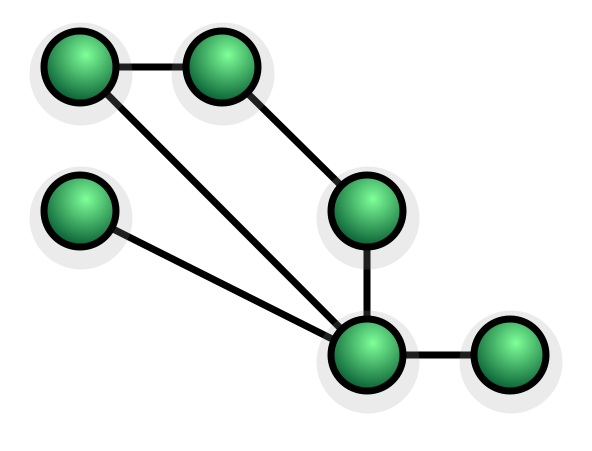
At its core, a mesh topology functions by establishing direct, dynamic, and often redundant links between network nodes. Each node acts as both a client and a router, capable of forwarding data for other nodes. This distributed intelligence means there's no single point of failure; if one node goes offline, traffic can be rerouted through alternative paths, a process often managed by sophisticated routing protocols like Optimized Link State Routing (OLSR) or Better Approach To Mobile Ad-hoc Networking (B.A.T.M.A.N.). Data packets hop from node to node until they reach their destination. The 'self-configuring' aspect is crucial: nodes automatically discover and establish connections with their neighbors, adapting to changes in network topology in real-time. This contrasts sharply with star topologies, where all devices connect to a central hub, or bus topologies, where all devices share a single communication line.
📊 Key Facts & Numbers
The scale of mesh networks can vary dramatically, from a handful of devices in a smart home to millions of nodes in a city-wide wireless mesh network. For instance, Google Fiber has explored mesh architectures for its home networking solutions, aiming for seamless Wi-Fi coverage across larger residences. In industrial settings, wireless sensor networks (WSNs) often employ mesh topologies, with thousands of low-power sensors collecting data across vast areas, such as agricultural fields or environmental monitoring sites.
👥 Key People & Organizations
While Paul Baran's foundational work in the 1960s is critical, the practical realization and widespread adoption of mesh networking owe much to various research institutions and companies. DARPA (Defense Advanced Research Projects Agency) has consistently funded research into robust, decentralized communication systems, including those that underpin mesh concepts. Companies like Aruba Networks (now part of Hewlett Packard Enterprise) and Cisco Systems have developed enterprise-grade wireless mesh solutions for large venues and campuses. In the open-source community, projects like Freifunk and Guifi.net have championed community-driven mesh networks, empowering individuals to build their own decentralized internet infrastructure. David Wood and Tim O'Reilly have also been influential in advocating for decentralized technologies that mesh networks embody.
🌍 Cultural Impact & Influence
Mesh topology has profoundly influenced the way we think about connectivity, moving away from centralized control towards distributed resilience. Its principles are visible in the architecture of the World Wide Web, which, despite its client-server nature, relies on a vast, interconnected network of routers and servers forming a de facto mesh. The rise of Internet of Things (IoT) devices has further propelled mesh networking into the mainstream, enabling devices like smart lights, thermostats, and security cameras to communicate efficiently and reliably within a home or building. This has fostered a cultural shift towards ambient computing and seamless device interaction, where the network itself becomes an invisible, intelligent layer. The concept also resonates with philosophies of decentralization and peer-to-peer file sharing, influencing movements advocating for greater user control over data and infrastructure.
⚡ Current State & Latest Developments
The current landscape of mesh networking is dynamic, driven by advancements in 5G and Wi-Fi 6 technologies, which incorporate mesh capabilities for enhanced coverage and reliability. IoT devices continue to proliferate, with many employing low-power mesh protocols like Zigbee and Thread for home automation and industrial monitoring. Companies are increasingly deploying large-scale wireless mesh networks for smart cities, providing connectivity for public Wi-Fi, traffic management, and utility monitoring. Emerging research is exploring blockchain integration to create even more secure and decentralized mesh networks, where nodes can be incentivized to participate and data integrity is cryptographically guaranteed. The development of Software-Defined Networking (SDN) is also enabling more sophisticated management and orchestration of complex mesh infrastructures.
🤔 Controversies & Debates
The primary controversy surrounding mesh topology often revolves around performance and scalability compared to traditional wired networks. While resilient, the 'hop-by-hop' data transmission can introduce latency, which is a concern for real-time applications like high-frequency trading or competitive online gaming. The complexity of managing a large, dynamic mesh network can also be a challenge, requiring advanced routing algorithms and robust network management tools. Furthermore, the decentralized nature can raise security concerns; while redundancy enhances fault tolerance, it can also create more potential entry points for malicious actors if not properly secured with strong encryption and authentication protocols. Debates also persist regarding the true 'decentralization' of many commercial mesh solutions, with some critics arguing that they still rely on proprietary cloud backends that reintroduce central points of control.
🔮 Future Outlook & Predictions
The future of mesh topology appears increasingly integrated into the fabric of our digital lives. We can expect to see more sophisticated AI-driven routing algorithms that optimize performance and energy efficiency in real-time. The expansion of Vehicle-to-Everything (V2X) communication will heavily rely on mesh networking principles to enable cars to communicate with each other and with infrastructure, enhancing road safety and traffic flow. The vision of a truly decentralized internet, often referred to as the Web3 or the 'decentralized web,' is intrinsically linked to the widespread adoption of mesh technologies, potentially reducing reliance on large internet service providers. Furthermore, advancements in quantum computing may eventually necessitate new forms of quantum-resistant mesh networking to secure future communications.
💡 Practical Applications
Mesh topology finds practical application across a wide spectrum of industries and use cases. In smart homes, Zigbee and Thread-based devices create robust networks for lighting, security, and climate control. Industrial IoT (IIoT) leverages mesh for monitoring and control in factories, oil rigs, and agricultural settings, where wired infrastructure is impractical or too costly. Public safety and disaster response teams utilize mobile ad-hoc mesh networks for communication in areas where traditional infrastructure is damaged or unavailable.
Key Facts
- Category
- technology
- Type
- topic