
Contents
Overview
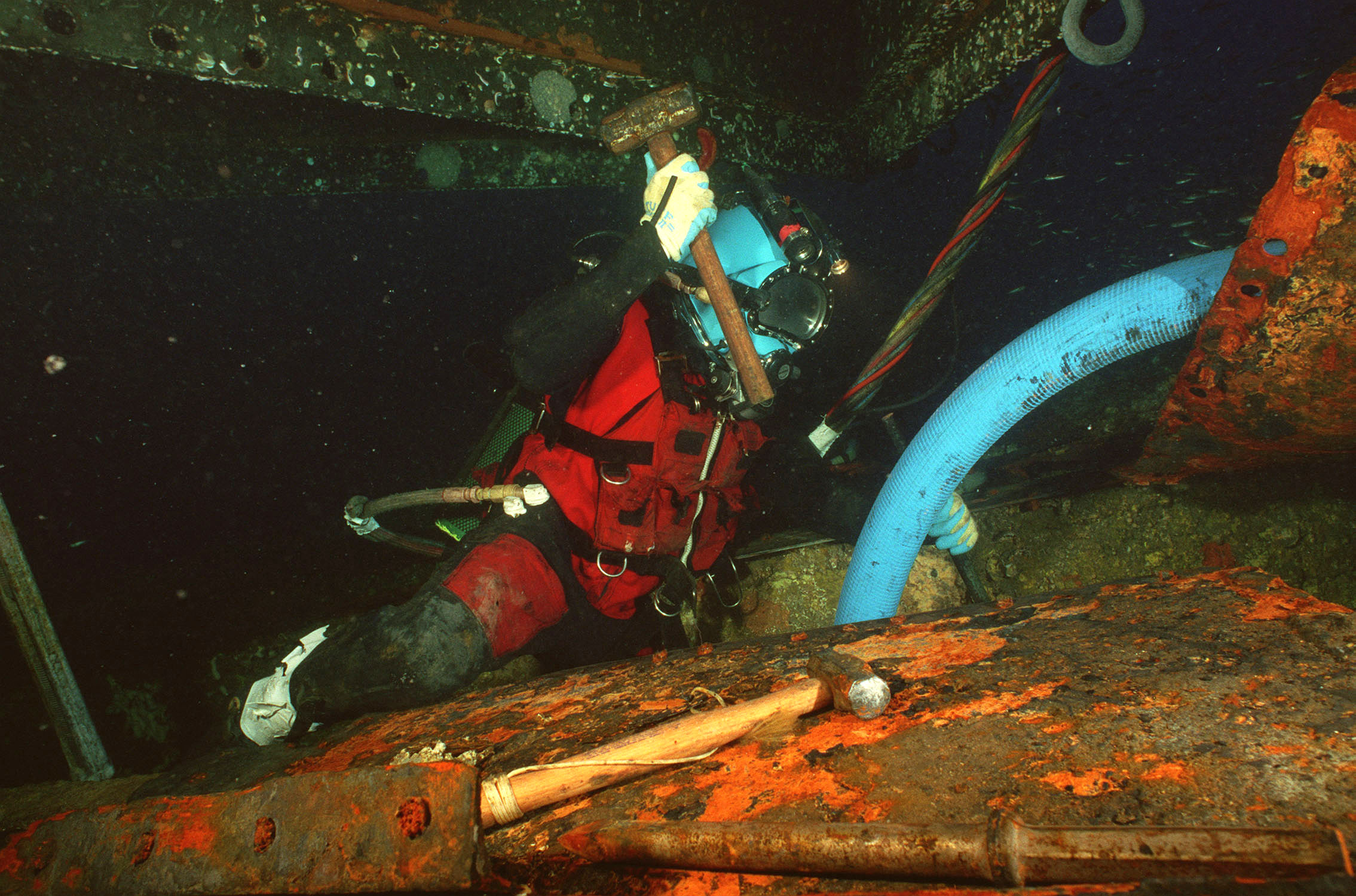
Long diving times, most notably achieved through saturation diving, represent a specialized form of underwater exploration and work that allows humans to remain at significant depths for extended durations, often spanning days or even weeks. This technique involves breathing a gas mixture under ambient pressure, saturating the body's tissues with inert gases. Once saturation is reached, the decompression time required to return to the surface remains constant regardless of further time spent at depth, dramatically increasing operational efficiency for tasks like offshore construction and underwater archaeology. Unlike standard diving, saturation divers experience the full ambient pressure only while submerged, minimizing the cumulative physiological stress of repeated ascents and descents. The practice, while enabling unprecedented underwater presence, also magnifies the physiological and psychological challenges associated with prolonged exposure to extreme environments, demanding rigorous training and meticulous safety protocols.
🎵 Origins & History
The concept of extended underwater stays predates modern saturation diving. The true genesis of saturation diving as a viable operational technique emerged in the mid-20th century, driven by the burgeoning oil and gas industry's need for deeper and longer underwater operations. Pioneers like Edwin Link and Robert Stewart conducted foundational research. The first successful saturation dive was conducted by the French diving company COMEX in 1963, with divers Jacques Piccard and Robert Sténuit spending 24 hours at 100 meters (328 feet) in the bathyscaphe Archimède. This marked a pivotal moment, demonstrating the feasibility of extended work at depth. Subsequent advancements by organizations like the U.S. Navy and commercial entities refined the gas mixtures and decompression schedules, paving the way for weeks-long missions.
⚙️ How It Works
Saturation diving operates on the principle of gas saturation. Divers breathe a specialized gas mixture, typically helium and oxygen (heliox), under the ambient pressure of their working depth. This causes inert gases, primarily helium, to dissolve into the diver's body tissues. Once the tissues reach equilibrium, or 'saturation,' with the breathing gas, the diver can remain at that depth for extended periods without increasing the risk or duration of decompression. The critical advantage is that decompression is only required once at the end of the entire mission, which can last for weeks. This single, prolonged decompression process is significantly more efficient than the multiple, shorter decompressions required for conventional diving, allowing for more productive time spent working underwater. Specialized diving habitats or support vessels serve as living quarters at depth, maintaining the required ambient pressure.
📊 Key Facts & Numbers
The typical duration of a saturation dive mission ranges from 10 to 28 days, with some missions extending to 40 days. Divers often work at depths between 100 and 300 meters (328 to 984 feet), though experimental dives have reached depths exceeding 500 meters (1,640 feet). A single decompression from such depths can take anywhere from 5 to 30 days, highlighting the efficiency gained by saturating. For instance, a diver spending 20 days at 200 meters would require a decompression schedule that might take nearly as long as the bottom time itself if done conventionally, but only a single, albeit lengthy, decompression when saturated. The cost of a saturation diving spread, including the vessel, habitat, and crew, can exceed $100,000 per day. Approximately 500-1,000 commercial saturation divers are active globally at any given time, with an estimated 5,000-10,000 individuals trained in the discipline worldwide.
👥 Key People & Organizations
Key figures in the development of saturation diving include Edwin Link, an American inventor and pioneer in underwater technology, and Robert Stewart, a physiologist whose research was crucial for understanding gas saturation. The French company COMEX, founded by Pierre Cabanel, conducted some of the earliest successful saturation dives, notably the 'Physalie VI' experiment in 1963. The U.S. Navy Experimental Diving Unit (EDU) has been instrumental in advancing saturation diving techniques and safety protocols for military applications. Major commercial diving companies like Subsea 7, TechnipFMC, and Heerema Marine Contractors regularly employ saturation diving teams for complex offshore projects. The International Marine Contractors Association (IMCA) sets industry standards and guidelines for saturation diving operations.
🌍 Cultural Impact & Influence
Saturation diving has profoundly influenced the offshore oil and gas industry, enabling the construction and maintenance of deepwater platforms and pipelines that would otherwise be impossible. It has also opened new frontiers for underwater archaeology, allowing researchers to spend extended periods excavating and studying submerged historical sites, such as the ancient Roman harbor of Caesarea Maritima. The psychological and physiological adaptations required for saturation diving have also contributed to broader human physiology research, particularly concerning the effects of extreme pressure and isolation. While not a mainstream cultural phenomenon, the mystique of 'living underwater' has occasionally filtered into popular culture through documentaries and fictional portrayals, albeit often sensationalized.
⚡ Current State & Latest Developments
The current state of saturation diving is characterized by continuous refinement of safety protocols and technological advancements aimed at reducing decompression times and improving diver well-being. Companies are investing in more sophisticated diving habitats and remotely operated vehicles (ROVs) that can perform some tasks, potentially reducing the need for human divers in the most hazardous conditions. There's also a growing focus on the long-term health impacts of saturation diving, with ongoing research into neurological effects and decompression sickness. The industry is also exploring new gas mixtures and diving profiles to enhance efficiency and safety. The ongoing demand for deepwater resource exploration and infrastructure maintenance ensures the continued relevance of saturation diving, though it faces increasing competition from advanced robotics and autonomous underwater vehicles (AUVs).
🤔 Controversies & Debates
A significant controversy surrounding saturation diving revolves around the long-term health risks to divers. While decompression sickness (the 'bends') is managed through controlled ascent, concerns persist about potential cumulative neurological damage, joint issues, and psychological stress from prolonged confinement and isolation. The ethical implications of exposing humans to such extreme environments for extended periods are also debated, particularly when robotic alternatives are becoming increasingly capable. Furthermore, the high cost of saturation diving operations can lead to pressure to cut corners on safety, a risk that industry bodies like IMCA strive to mitigate through stringent regulations and oversight. The debate between human operational capacity and the increasing sophistication of unmanned underwater vehicles also presents a strategic challenge for the future of the profession.
🔮 Future Outlook & Predictions
The future of long diving times will likely see a hybrid approach, with saturation diving continuing for highly complex tasks where human dexterity and judgment are indispensable, but with a greater integration of robotic assistance. Research into faster decompression techniques, possibly involving specialized gas mixtures or hyperbaric chambers, could shorten mission turnaround times. Advances in life support systems and habitat design will aim to improve diver comfort and reduce psychological strain. There's also potential for saturation diving techniques to be adapted for future space exploration missions, particularly for extended stays on extraterrestrial bodies with subsurface oceans, such as Europa. The ultimate goal remains to maximize productive underwater time while minimizing risk and physiological burden.
💡 Practical Applications
Saturation diving's primary application is in the offshore oil and gas industry, where divers perform complex tasks such as installing and repairing subsea structures, pipelines, and wellheads in depths exceeding 300 meters. It is also crucial for underwater construction projects, including bridge foundations, harbor works, and tunnel construction. Underwater archaeologists utilize saturation diving to conduct extensive, long-term excavations of submerged historical sites. Scientific research, such as studying deep-sea ecosystems or geological formations, also benefits from extended human presence at de
Key Facts
- Category
- technology
- Type
- topic