
Contents
Overview
The genesis of Lie algebras lies in the pioneering work of Norwegian mathematician Sophus Lie during the 1870s and 1880s. Lie sought to generalize the Galois theory of algebraic equations to differential equations. Lie aimed to classify continuous transformation groups, which he termed Lie groups. He realized that the infinitesimal transformations of these groups formed an algebraic structure, which we now call a Lie algebra. Early collaborators and contemporaries like Friedrich Engel were instrumental in developing and formalizing Lie's ideas. The abstract definition of a Lie algebra, focusing on the vector space and the bracket operation satisfying specific axioms, emerged more formally in the early 20th century through the efforts of mathematicians such as Elijah Jordan and Hermann Weyl, who recognized their profound connection to quantum mechanics.
⚙️ How It Works
At its core, a Lie algebra g is a vector space over a field (typically the real numbers R or complex numbers C) endowed with a binary operation called the Lie bracket, denoted [ , ]. This bracket must satisfy three key properties: bilinearity ([ax + by, z] = a[x, z] + b[y, z] and [x, ay + bz] = a[x, y] + b[x, z]), alternating ([x, x] = 0 for all x in g), and the Jacobi identity ([x, [y, z]] + [y, [z, x]] + [z, [x, y]] = 0 for all x, y, z in g). The alternating property implies antisymmetry: [x, y] = -[y, x]. A canonical example is the algebra of n x n matrices with the bracket defined as the commutator: [A, B] = AB - BA. This structure captures the essence of infinitesimal transformations and is fundamental to understanding the structure of Lie groups, which are smooth manifolds that are also groups.
📊 Key Facts & Numbers
The simple Lie algebra of type A_n corresponds to the special linear Lie algebra sl(n+1, C), which has dimension (n+1)^2 - 1. The exceptional Lie algebra g2 has a dimension of 14. In physics, the Poincaré group, which describes spacetime symmetries in special relativity, has a 10-dimensional Lie algebra. The SU(2) Lie algebra is crucial for describing spin and has dimension 3, isomorphic to so(3). The study of Lie algebras involves concepts like roots, weights, and representations, with the latter often having dimensions in the hundreds or thousands for complex physical models.
👥 Key People & Organizations
The foundational figure is undoubtedly Sophus Lie. Friedrich Engel was a key collaborator in developing Lie's theories. Later, Elijah Jordan played a critical role in the classification of simple Lie algebras. Hermann Weyl was instrumental in connecting Lie groups and Lie algebras to quantum mechanics and group representation theory. In modern times, mathematicians like Nicolas Bourbaki (a collective pseudonym) have contributed to their axiomatic treatment, and physicists like Murray Gell-Mann utilized them extensively in particle physics. Key organizations advancing this research include the American Mathematical Society and the London Mathematical Society, which host conferences and publish journals like the 'Annals of Mathematics' and 'Communications in Mathematical Physics'.
🌍 Cultural Impact & Influence
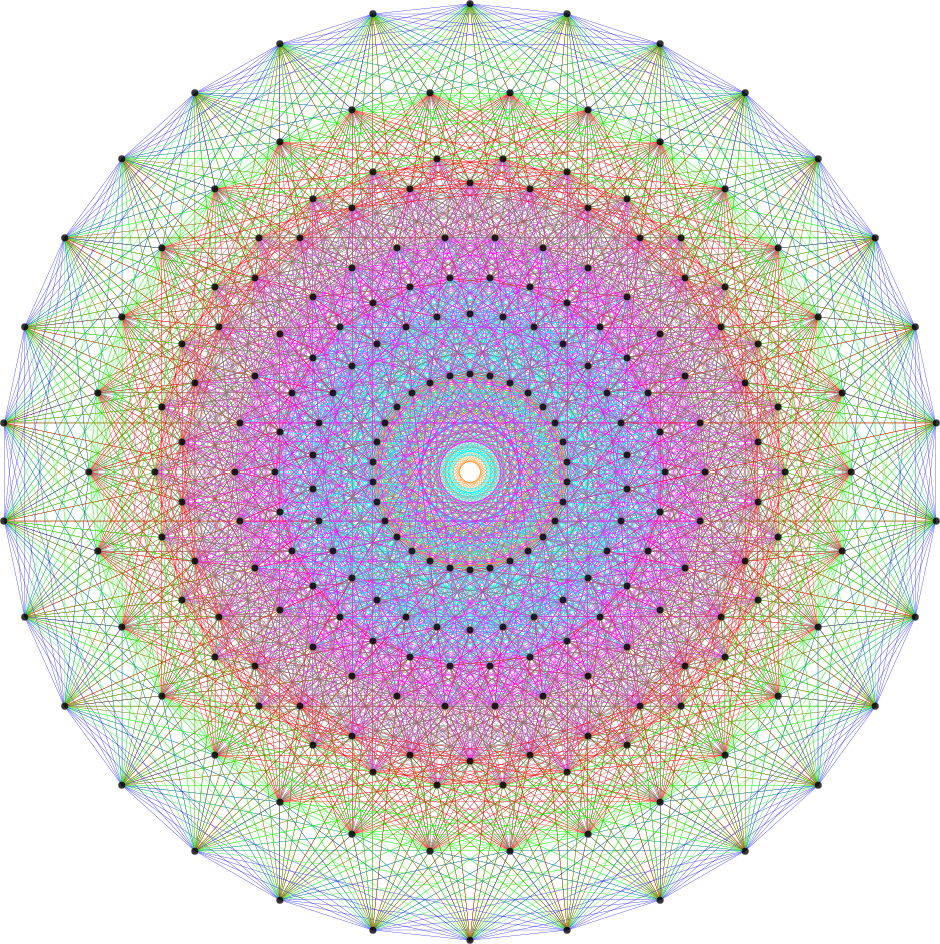
Lie algebras are the mathematical language of continuous symmetry. Their influence permeates theoretical physics, providing the framework for understanding fundamental forces and particles. In quantum mechanics, the SU(2) Lie algebra describes the spin of particles, a concept that revolutionized our understanding of atomic structure. The Poincaré group's Lie algebra encapsulates the symmetries of spacetime in special relativity, forming the basis for relativistic quantum field theories. Particle physicists use Lie algebras, particularly the exceptional ones like E8, to classify elementary particles and their interactions within models like the Standard Model and beyond. Beyond physics, Lie algebras find applications in differential geometry, control theory, and even cryptography, demonstrating a broad cultural resonance as a powerful tool for abstract reasoning and problem-solving.
⚡ Current State & Latest Developments
Current research in Lie algebras is vibrant, focusing on areas like infinite-dimensional Lie algebras (e.g., Kac-Moody algebras and Virasoro algebras) which are crucial for conformal field theory and string theory. There's also significant work on quantum groups, which are deformations of universal enveloping algebras of Lie algebras, and their connections to integrable systems. The development of computational tools for Lie algebra computations, such as the LieART package in Mathematica, is making these abstract structures more accessible.
🤔 Controversies & Debates
A persistent debate revolves around the pedagogical approach to introducing Lie algebras. Some argue for a top-down approach, starting with Lie groups and their infinitesimal generators, as Hermann Weyl did, emphasizing their physical relevance. Others advocate for a bottom-up, axiomatic approach, focusing on the algebraic structure itself, which can be more abstract but builds a rigorous foundation. Another area of contention, particularly in physics, is the interpretation of the 'reality' of higher-dimensional symmetries suggested by exceptional Lie algebras like E8; while mathematically elegant, their direct physical manifestation remains an open question. The computational complexity of working with large Lie algebras also presents ongoing challenges, leading to debates about the most efficient algorithms and software implementations.
🔮 Future Outlook & Predictions
The future of Lie algebra research is likely to be deeply intertwined with advances in theoretical physics and pure mathematics. We can expect further exploration of infinite-dimensional Lie algebras in the context of quantum gravity and string theory, potentially revealing new fundamental symmetries of nature. The interplay between Lie algebras and areas like non-commutative geometry and category theory is expected to deepen, leading to new conceptual frameworks. In applied mathematics, Lie algebraic methods may become more prevalent in areas such as machine learning, robotics, and data science, as researchers seek to leverage symmetry principles for more efficient and robust algorithms. The ongoing quest for a unified theory of fundamental forces might also uncover new, perhaps unexpected, Lie algebraic structures.
💡 Practical Applications
Lie algebras are indispensable in theoretical physics. They are used to classify elementary particles and their interactions via gauge theories like QCD and electroweak theory. The SU(3) Lie algebra is fundamental to the strong nuclear force, while SU(2) and U(1) describe the weak nuclear force and electromagnetism, respectively. In quantum mechanics, the angular momentum operators form a so(3) Lie algebra, crucial for understanding atomic and molecular spectra. Beyond physics, Lie algebras are applied in control theory to analyze the controllability of nonlinear systems and in robotics for motion planning. Their structure also appears in the stud
Key Facts
- Category
- science
- Type
- topic