
Contents
Overview
The conceptual roots of the horizontal coordinate system stretch back to antiquity, with early astronomers like Hipparchus developing sophisticated methods for mapping the heavens. While the equatorial coordinate system became dominant for star catalogs due to its stability relative to the celestial sphere, the practical need to point instruments at specific, transient objects necessitated an observer-centric approach. Early forms of alt-azimuth tracking were likely employed for celestial navigation by ancient mariners. The formalization of the system, alongside its mathematical underpinnings, evolved over centuries, with key contributions from mathematicians and astronomers refining its application in fields like surveying and geodesy, long before its widespread adoption in modern telescope mounts.
⚙️ How It Works
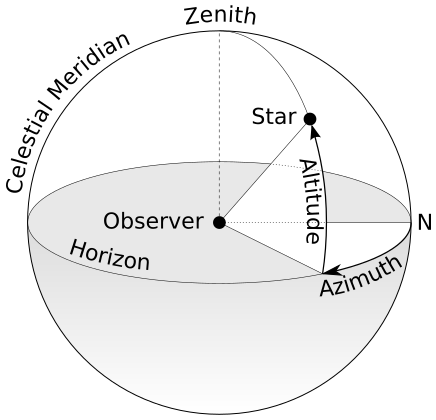
At its core, the horizontal coordinate system is defined by two primary angles relative to the observer's local horizon. Altitude (often denoted as 'alt' or 'el' for elevation) measures the angular distance of an object above the horizon. Azimuth (often denoted as 'az') measures the object's horizontal direction along the horizon, typically starting from North (0°), moving through East (90°), South (180°), and West (270°), completing a full 360° circle. Because the Earth rotates, the alt-azimuth coordinates of any celestial object (except those directly above the poles) are constantly changing, requiring continuous adjustment for tracking. This dynamic nature contrasts sharply with more stable systems like the equatorial coordinate system.
📊 Key Facts & Numbers
The horizontal coordinate system is inherently tied to the observer's location on Earth, meaning coordinates for the same celestial object will differ significantly between, say, London and Sydney at the same moment. An object at an altitude of 30° will have a different azimuth depending on the observer's longitude and the object's declination. The zenith, directly overhead, has an altitude of 90°, while objects on the horizon have an altitude of 0°. The horizon itself is the fundamental plane, dividing the celestial sphere into visible and invisible hemispheres for a given observer. The system is particularly useful for amateur astronomers and for pointing telescope mounts in real-time.
👥 Key People & Organizations
While no single individual 'invented' the horizontal coordinate system, its development and application have been shaped by numerous figures. Early astronomical work by Ptolemy in his Almagest laid groundwork for celestial mapping, though he primarily used an equatorial system. Later, figures like Tycho Brahe utilized sophisticated observational instruments that implicitly relied on alt-azimuth measurements for pointing. Modern telescope design, particularly for robotic telescopes and satellite tracking stations, owes much to engineers and astronomers who refined alt-azimuth mount mechanics and control algorithms. Organizations like the International Astronomical Union (IAU) standardize astronomical conventions, including coordinate systems.
🌍 Cultural Impact & Influence
The horizontal coordinate system's most profound cultural impact lies in its direct connection to our lived experience of the sky. It's the system we intuitively use when pointing out a star or planet to someone – 'Look up there, a bit to the left.' This accessibility has made it a cornerstone of amateur astronomy and astrophotography, allowing enthusiasts to engage directly with the cosmos. It also underpins the historical practice of celestial navigation, enabling mariners to chart courses using the stars. The visual representation of the sky through alt-azimuth diagrams, like the one found in Wikimedia Commons' Azimuth-Altitude schematic.svg, has become a familiar icon for understanding astronomical observation.
⚡ Current State & Latest Developments
The horizontal coordinate system remains indispensable for real-time astronomical observation and tracking. Advanced robotic telescopes and ground-based observatories routinely employ alt-azimuth mounts for their efficiency and ability to cover the entire sky. The development of increasingly sophisticated adaptive optics systems and interferometry techniques, while often using equatorial mounts for stability, still rely on alt-azimuth pointing for initial acquisition and tracking. Furthermore, the proliferation of smartphone apps that overlay celestial information onto the live camera feed directly utilize the phone's sensors to calculate and display alt-azimuth coordinates for astronomical objects, making this ancient system more accessible than ever.
🤔 Controversies & Debates
A persistent debate in astronomy concerns the optimal coordinate system for different observational tasks. While the equatorial coordinate system offers stability for long-exposure imaging and cataloging due to its alignment with the celestial poles, the horizontal system's observer-dependence can be a drawback. For instance, tracking a celestial object for extended periods with an alt-azimuth mount requires constant, complex adjustments to counteract Earth's rotation, leading to potential tracking errors and field rotation, which can degrade image quality in astrophotography. This has led to hybrid mount designs and sophisticated software corrections to mitigate these issues.
🔮 Future Outlook & Predictions
The future of the horizontal coordinate system is likely to be one of continued integration with advanced technologies. As AI and machine learning become more prevalent in astronomical data processing, predictive algorithms will further refine alt-azimuth tracking, compensating for atmospheric distortion and mechanical imperfections with unprecedented accuracy. The development of space-based observatories may reduce reliance on ground-based alt-azimuth systems for certain applications, but the fundamental need to point instruments at specific sky locations will ensure its continued relevance. Expect to see even more seamless integration with augmented reality interfaces, allowing users to 'see' celestial coordinates overlaid on their real-world view.
💡 Practical Applications
The horizontal coordinate system finds extensive practical application in several key areas. It is the primary system used for pointing and tracking in most amateur telescopes, from small refractors to large Dobsonian reflectors, enabling users to locate and follow planets, nebulae, and galaxies. In professional astronomy, alt-azimuth mounts are favored for large, modern telescopes like the Gran Telescopio Canarias and the Keck Observatory due to their simpler mechanical design and wider field of view compared to equatorial mounts of equivalent size. It's also crucial for radio astronomy, guiding large dish antennas to track celestial radio sources, and in satellite tracking and missile tracking operations where precise, real-time pointing is paramount.
Key Facts
- Category
- science
- Type
- topic