
Contents
Overview
The origins of Hindu education trace back to the Vedic period, where knowledge was primarily transmitted orally through hymns and rituals. The concept of 'Gurukula' emerged, a residential system where students lived with their teacher (Guru), dedicating themselves to learning and service. This era saw the compilation of foundational texts like the Rig Veda, Yajur Veda, Sama Veda, and Atharva Veda, which formed the core curriculum. Later philosophical texts like the Upanishads and epics like the Mahabharata and Ramayana further shaped the educational ethos, emphasizing introspection and ethical living. The development of systematic disciplines like Nyaya (logic) and Vaisheshika (atomism) by scholars such as Gautama Maharishi and Kanada demonstrated a sophisticated intellectual tradition. Institutions like Nalanda University and Takshashila (ancient Taxila) flourished as centers of higher learning, attracting scholars from across Asia, showcasing a robust academic infrastructure long before modern universities existed.
⚙️ How It Works
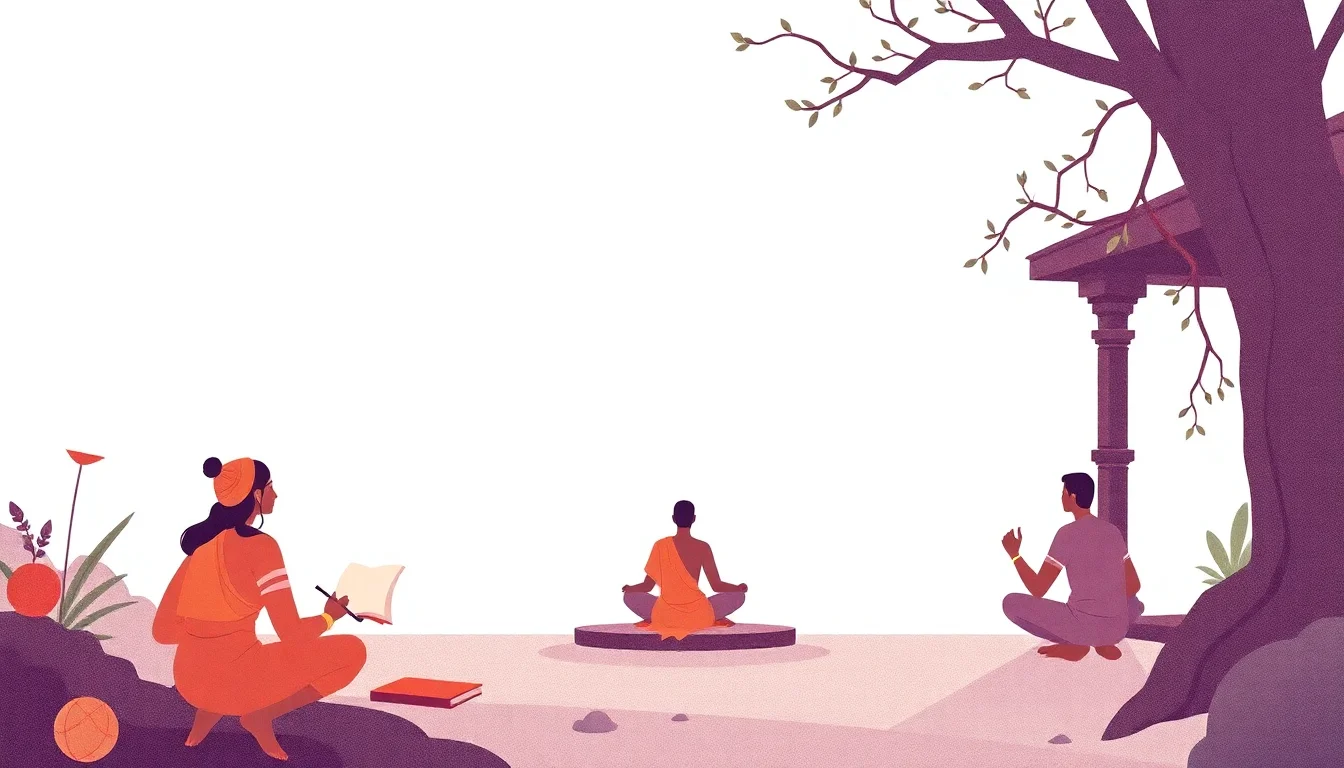
At its heart, Hindu education is a holistic process aimed at the development of the entire individual – body, mind, and spirit. The Guru-shishya parampara (teacher-disciple lineage) is central, fostering a relationship of trust, respect, and deep personal guidance. Learning was experiential, often involving meditation, chanting, philosophical debate, and practical application of knowledge. The curriculum was broad, encompassing not only spiritual texts but also practical sciences like Ayurveda (traditional Indian medicine), Jyotisha (astronomy/astrology), Ganita (mathematics), and Shilpa Shastra (arts and architecture). The goal was not merely vocational training but the cultivation of 'Jnana' (knowledge), 'Vijnana' (wisdom), and 'Moksha' (liberation). Students were encouraged to question, reflect, and integrate learning into their lives, striving for self-realization and contributing to societal well-being through their actions and character.
📊 Key Facts & Numbers
Historically, the Gurukul system was the primary mode of education. The Arthashastra by Chanakya details administrative and economic principles, indicating a sophisticated understanding of statecraft and societal organization. Ancient Indian mathematicians developed the concept of zero and the decimal system, fundamental to modern mathematics. The Nalanda University and Takshashila were significant centers of learning. Modern Hindu educational institutions cater to a growing demographic; for instance, the Chinmaya Mission operates schools globally, imparting a blend of secular and spiritual education. The global Hindu diaspora also contributes significantly, with thousands of weekend 'Balavihar' classes educating children in Hindu values and traditions.
👥 Key People & Organizations
Key figures in the history of Hindu education include ancient sages and philosophers like Vyasa, credited with compiling the Mahabharata, and Adi Shankara, a pivotal philosopher who revitalized Advaita Vedanta and established monastic centers (Mathas) that served as educational hubs. During the colonial era, reformers like Swami Vivekananda advocated for a system that combined modern science with spiritual strength, leading to the establishment of the Ramakrishna Mission and its educational initiatives. More recently, spiritual leaders like Swami Chinmayananda Saraswati founded the Chinmaya Mission, which has grown into a global organization with a vast network of schools and study groups. Organizations like the Vishwa Hindu Parishad (VHP) also play a role in promoting Hindu cultural and educational values through various programs and publications.
🌍 Cultural Impact & Influence
Hindu education has profoundly influenced not only the Indian subcontinent but also global thought and spirituality. Its emphasis on yoga, meditation, and mindfulness has been widely adopted in the West, with practices originating from Hindu traditions now integrated into wellness and mental health sectors worldwide. The philosophical underpinnings of karma, dharma, and reincarnation have permeated global consciousness, influencing ethical frameworks and spiritual seeking. Ancient Indian scientific contributions, such as the decimal system and early algebraic concepts, laid groundwork for modern scientific advancement. The concept of 'Vasudhaiva Kutumbakam' (the world is one family), a core tenet often associated with Hindu philosophy, promotes a global perspective on interconnectedness and shared responsibility, influencing international relations and environmental ethics. The dissemination of Hindu scriptures and philosophical texts through translations by scholars like Sir Edwin Arnold (author of 'The Song of God: Bhagavad Gita') introduced these ideas to a wider audience, sparking interest in Eastern philosophies.
⚡ Current State & Latest Developments
In the 21st century, Hindu education is experiencing a resurgence, driven by a desire to reconnect with cultural roots and seek value-based learning. Numerous organizations, such as the Chinmaya Mission, Art of Living Foundation, and ISKCON (International Society for Krishna Consciousness), operate schools and educational programs globally, offering curricula that blend secular subjects with Hindu philosophy, ethics, and practices like yoga and meditation. The Indian government's National Education Policy (NEP) 2020 has also shown an inclination towards integrating Indian Knowledge Systems (IKS) into mainstream education, potentially creating more space for traditional Hindu educational philosophies. Digital platforms are increasingly being used to disseminate teachings, with online courses, webinars, and virtual study groups becoming popular avenues for learning, reaching a global audience beyond geographical limitations.
🤔 Controversies & Debates
The integration of Hindu education into modern curricula is not without its controversies. Critics often raise concerns about the potential for religious indoctrination in secular educational spaces, questioning the separation of church and state. Debates persist regarding the historical accuracy and interpretation of ancient texts, with some scholars arguing for critical engagement rather than unquestioning acceptance. There are also discussions about the relevance of certain traditional practices in a contemporary, globalized world, and whether they adequately prepare students for the demands of the modern workforce. Furthermore, the influence of political ideologies on the interpretation and promotion of Hindu education in India has led to accusations of saffronization, sparking heated debates about national identity and secularism.
🔮 Future Outlook & Predictions
The future of Hindu education likely lies in a dynamic synthesis of ancient wisdom and modern pedagogy. Expect a greater emphasis on integrating Indian Knowledge Systems (IKS) into mainstream curricula, driven by policies like India's NEP 2020. Technology will play an increasingly crucial role, with AI-powered learning platforms and VR experiences potentially bringing ancient texts and philosophical concepts to life. There's a growing global interest in contemplative practices and value-based education, which Hindu traditions are well-positioned to address. However, navigating the controversies surrounding religious and political influences will be critical. Success will depend on fostering critical thinking alongside spiritual development, ensuring that Hindu education remains relevant, inclusive, and a force for positive societal transformation, rather than a to
Key Facts
- Category
- culture
- Type
- topic