
Contents
- 🎵 Origins & History
- ⚙️ How It Works
- 📊 Key Facts & Numbers
- 👥 Key People & Organizations
- 🌍 Cultural Impact & Influence
- ⚡ Current State & Latest Developments
- 🤔 Controversies & Debates
- 🔮 Future Outlook & Predictions
- 💡 Practical Applications
- 📚 Related Topics & Deeper Reading
- Frequently Asked Questions
- References
- Related Topics
Overview
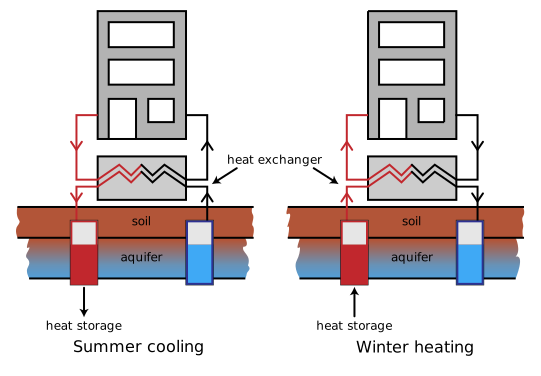
Geothermal heat pumps (GHPs), also known as ground source heat pumps (GSHPs), represent a sophisticated approach to building climate control by leveraging the Earth's consistent subterranean temperatures. Unlike conventional HVAC systems that battle extreme ambient air fluctuations, GHPs tap into the relatively stable thermal reservoir found just a few feet below the surface. This technology utilizes a network of underground pipes, or 'ground loops,' to transfer heat between a building and the earth. During winter, heat is extracted from the ground and delivered into the building; in summer, the process is reversed, moving heat from the building into the cooler earth. This method boasts significant energy efficiency, with Coefficients of Performance (CoP) typically ranging from 3 to 6, meaning they deliver 3 to 6 units of heat for every unit of electricity consumed. While initial installation costs, particularly for drilling boreholes or laying extensive ground loops, can be substantial, the long-term operational savings and reduced environmental impact make them an increasingly attractive option, especially for new construction projects. The global market for geothermal heat pumps is projected to reach billions of dollars, driven by rising energy costs and a growing demand for sustainable building solutions.
🎵 Origins & History
The concept of utilizing the Earth's stable temperature for heating and cooling dates back to the early 20th century, with initial experiments in the 1920s and 1930s. Early pioneers like Vance Allen explored the potential of ground-coupled heat pumps, with the first patent for a geothermal heat pump system filed by Allen in 1912. However, widespread adoption remained elusive due to technological limitations and high upfront costs. Significant advancements in heat pump technology and drilling techniques in the latter half of the 20th century, particularly spurred by the energy crises of the 1970s, brought geothermal systems into greater prominence. Organizations like the International Energy Agency began to formally study and promote these technologies. By the 1990s, geothermal heat pump consortiums were established in North America to standardize installations and advocate for their benefits, laying the groundwork for the modern geothermal industry.
⚙️ How It Works
Geothermal heat pumps operate on a closed-loop or open-loop system that circulates a fluid (typically water or an antifreeze solution) through underground pipes. This fluid acts as a heat exchange medium. In heating mode, the fluid absorbs heat from the earth, which maintains a steady temperature of around 45-75°F (7-24°C) year-round. This warmed fluid then flows to the heat pump unit inside the building, where a compressor concentrates the heat, making it hot enough to warm the building's air via a distribution system. In cooling mode, the process is reversed: the heat pump extracts heat from the building's air and transfers it to the fluid, which then dissipates the heat into the cooler ground. The efficiency of these systems, measured by the Coefficient of Performance (CoP), often exceeds 400%, meaning they can deliver four times more heat energy than the electrical energy they consume. Variable-refrigerant flow (VRF) systems, while distinct, share the goal of efficient climate control, but rely on different heat exchange mechanisms.
📊 Key Facts & Numbers
The global geothermal heat pump market is substantial and growing, with projections indicating a market size of over $10 billion by 2027, according to some industry analyses. The average Coefficient of Performance (CoP) for geothermal heat pumps typically ranges from 3 to 6, significantly outperforming air-source heat pumps which often have CoPs between 2.5 and 4. Installation costs can range from $20,000 to $40,000 for a typical residential system, with horizontal loop systems costing an average of $20-$30 per linear foot and vertical loop systems ranging from $30-$50 per linear foot. Despite these higher upfront expenses, geothermal systems can reduce heating and cooling energy bills by 30% to 70% compared to conventional systems. A single-family home can save an average of $500 to $1,000 annually on energy costs. The lifespan of underground loops is estimated to be 50 years or more, while the indoor heat pump unit typically lasts 20-25 years, far exceeding the 10-15 year lifespan of conventional furnaces and air conditioners.
👥 Key People & Organizations
Key figures in the development and promotion of geothermal heat pumps include Vance Allen, who patented early concepts, and researchers at institutions like Stanford University and the National Renewable Energy Laboratory (NREL) who have conducted extensive research into system efficiency and design. Major manufacturers of geothermal heat pump equipment include WaterFurnace, ClimateMaster, and the Geothermal Energy Association (GEA), which advocates for the technology. Organizations like the International Ground Source Heat Pump Association (IGSHPA) provide training and certification for installers, ensuring quality and safety standards. Alena Bleicher has contributed scholarly work, such as her 2016 article, analyzing the socio-technical aspects of geothermal energy adoption.
🌍 Cultural Impact & Influence
Geothermal heat pumps have a profound cultural impact by enabling a tangible connection to sustainable energy for homeowners and building managers. They represent a shift away from fossil fuel dependency towards utilizing natural, renewable resources directly beneath our feet. This technology has influenced architectural design, with new developments increasingly incorporating ground loops during construction phases, making sustainable infrastructure a standard feature rather than an afterthought. The quiet operation and aesthetic invisibility of underground loops also contribute to a more harmonious living environment. Furthermore, the economic benefits, such as reduced utility bills and increased property values, have fostered a positive perception of geothermal technology, driving its adoption and influencing public discourse around energy efficiency and environmental responsibility. The concept of 'passive house' design often integrates geothermal systems to achieve ultra-low energy consumption.
⚡ Current State & Latest Developments
The current state of the geothermal heat pump industry is one of robust growth, driven by increasing awareness of climate change and the economic advantages of energy efficiency. Governments worldwide are offering incentives, such as tax credits and rebates, to encourage adoption. For instance, the Inflation Reduction Act in the United States provides significant tax credits for geothermal installations. Technological advancements continue to improve efficiency and reduce installation costs, with innovations in drilling techniques and heat exchanger designs. The integration of geothermal systems with smart home technology and building management systems is also becoming more common, allowing for optimized performance and energy savings. The market is seeing increased competition among manufacturers and a growing number of certified installers, making the technology more accessible to a wider range of consumers.
🤔 Controversies & Debates
One of the primary controversies surrounding geothermal heat pumps revolves around their high upfront installation costs. While proponents highlight long-term savings, the initial investment can be a significant barrier for many homeowners and developers, particularly in regions without substantial government incentives. Another debate centers on the environmental impact of drilling and excavation required for ground loop installation, with concerns about potential disruption to local ecosystems and groundwater. Furthermore, the efficiency of open-loop systems, which draw water directly from aquifers, can be impacted by water quality and availability, leading to debates about their long-term sustainability in certain geological areas. The perceived complexity of installation compared to simpler air-source systems also fuels discussions about installer training and standardization.
🔮 Future Outlook & Predictions
The future outlook for geothermal heat pumps is exceptionally bright, with projections indicating continued rapid expansion. As renewable energy mandates become more stringent and energy prices remain volatile, the demand for highly efficient, low-emission heating and cooling solutions will only increase. Innovations in directional drilling and trenching technologies are expected to significantly reduce installation costs and time, making geothermal systems more competitive. The development of smaller, more modular geothermal units could also open up new markets, including retrofitting older buildings. Experts predict that geothermal heat pumps will play a crucial role in decarbonizing the building sector, contributing significantly to global climate goals. The integration with district heating and cooling networks is also a promising avenue for large-scale deployment.
💡 Practical Applications
Geothermal heat pumps have a wide array of practical applications across residential, commercial, and industrial sectors. In residential settings, they provide efficient heating, cooling, and hot water for single-family homes, townhouses, and apartment buildings. Commercially, they are used in office buildings, schools, hospitals, and retail centers to manage climate control and reduce operational expenses. Industrial applications include process heating and cooling, as well as climate control for data centers and manufacturing facilities where consistent temperatures are critical. Municipalities are increasingly exploring geothermal systems for public buildings, schools, and even for district heating and cooling networks serving entire neighborhoods. The technology is also being adapted for specialized uses, such as heating swimming pools and maintaining stable temperatures in greenhouses.
Key Facts
- Year
- Early 20th Century (conceptualization), 1970s (renewed interest)
- Origin
- United States (early patents and development)
- Category
- technology
- Type
- technology
Frequently Asked Questions
How do geothermal heat pumps actually work?
Geothermal heat pumps utilize a network of underground pipes, known as ground loops, to exchange heat with the earth. In winter, they extract heat from the ground and transfer it into the building for warmth. In summer, they reverse the process, drawing heat from the building and dissipating it into the cooler earth. This process relies on the stable temperature of the earth, typically between 45-75°F (7-24°C) year-round, making it a highly efficient method for heating and cooling.
What are the main advantages of geothermal heat pumps?
The primary advantages include exceptional energy efficiency, with Coefficients of Performance (CoP) often ranging from 3 to 6, meaning they deliver 3 to 6 units of heat for every unit of electricity consumed. This leads to significant reductions in energy bills, often 30% to 70% lower than conventional systems. Geothermal systems also have a longer lifespan (20-25 years for the indoor unit, 50+ years for ground loops) compared to traditional HVAC units, and they operate very quietly and discreetly, with no outdoor units visible.
Are geothermal heat pumps expensive to install?
Yes, the initial installation cost for geothermal heat pumps is typically higher than for conventional HVAC systems, often ranging from $20,000 to $40,000 for a residential installation. This is primarily due to the expense of drilling boreholes or excavating trenches for the underground ground loops. However, these higher upfront costs are often recouped over time through substantial energy savings and potential government incentives, such as tax credits and rebates.
What is the difference between a geothermal heat pump and a ground source heat pump?
Geothermal heat pump (GHP) and ground source heat pump (GSHP) are essentially interchangeable terms used to describe the same technology. The term 'geothermal' refers to the Earth's heat, while 'ground source' emphasizes that the heat is exchanged with the ground. In North America, 'geothermal heat pump' is more commonly used, while 'ground source heat pump' might be more prevalent in other regions. Both terms denote systems that leverage the stable underground temperatures for heating and cooling.
What are the potential environmental concerns with geothermal heat pumps?
While generally considered an environmentally friendly technology, concerns exist regarding the installation process. Drilling boreholes or excavating for ground loops can cause temporary disruption to local ecosystems and soil. For open-loop systems that draw water directly from aquifers, there can be concerns about water usage, potential impacts on groundwater levels, and the discharge of water, which could affect local water quality if not managed properly. However, these impacts are typically localized and manageable with proper planning and installation practices.
How much can I save on my energy bills with a geothermal system?
Homeowners can expect to save between 30% and 70% on their heating and cooling energy bills by switching to a geothermal heat pump system. For an average single-family home, this can translate to annual savings of $500 to $1,000 or more, depending on local energy prices, climate, and the efficiency of the installed system. These savings, combined with the system's longevity, contribute to a strong return on investment over the system's lifespan.
What is the future of geothermal heat pump technology?
The future of geothermal heat pump technology is very promising, with significant growth anticipated. Advancements in drilling techniques are expected to lower installation costs and speed up deployment. Innovations in system design, including more compact units and integration with smart home technology, will enhance efficiency and user experience. As governments worldwide implement stricter emissions regulations and promote renewable energy, geothermal systems are poised to become a cornerstone of sustainable building practices, potentially playing a major role in decarbonizing the built environment and supporting district heating and cooling networks.