
Contents
Overview
The genesis of the Gaussian distribution is a story woven through the work of several brilliant minds. While Abraham de Moivre first described it in 1733 as an approximation to the binomial distribution, it was Carl Friedrich Gauss who, in the early 19th century, applied it to analyze astronomical data, solidifying its association with his name. Independently, Pierre-Simon Laplace also explored its properties, particularly in the context of error analysis. The distribution's pervasive appearance in natural phenomena, often referred to as the Central Limit Theorem, further cemented its status as a foundational statistical model. Early applications were primarily in astronomy and geodesy, where measurement errors were a significant concern, but its utility soon expanded.
⚙️ How It Works
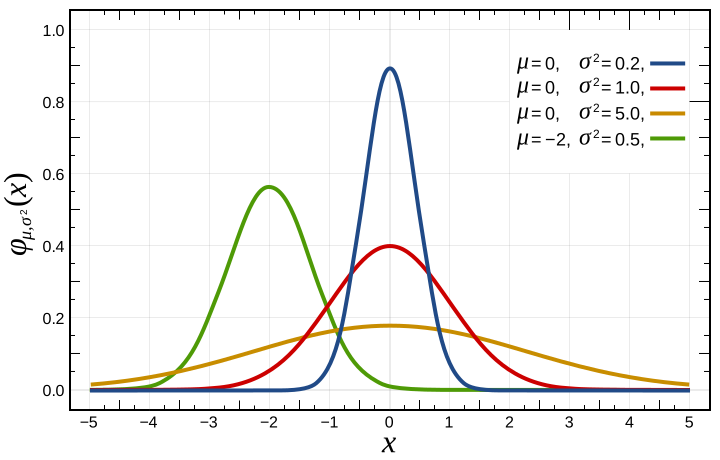
At its heart, the Gaussian distribution is defined by two parameters: the mean (μ), which dictates the center of the bell curve, and the standard deviation (σ), which measures the spread or variability of the data. The probability density function (PDF) of a Gaussian distribution is given by $f(x) = \frac{1}{\sigma\sqrt{2\pi}} e^{-\frac{1}{2}(\frac{x-\mu}{\sigma})^2}$. This formula means that data points cluster around the mean, with the frequency of observations decreasing symmetrically as they move further away. Approximately 68% of data falls within one standard deviation of the mean, 95% within two, and 99.7% within three, a property known as the empirical rule or the 68–95–99.7 rule. This predictable spread makes it invaluable for predicting ranges and understanding variability.
📊 Key Facts & Numbers
The Gaussian distribution is not just a theoretical construct; its presence is quantifiable. In human populations, adult heights in many countries approximate a normal distribution with a mean around 170 cm (5'7") for males and 160 cm (5'3") for females, with standard deviations typically between 6-8 cm. Stock market returns, while often debated, are frequently modeled using Gaussian assumptions, with daily returns in major indices like the S&P 500 exhibiting standard deviations of roughly 1%. In manufacturing, the precision of machined parts often follows a Gaussian distribution, with defect rates below 0.1% for processes operating within three standard deviations of the target. Even the scores on standardized tests like the SAT are designed to approximate a normal distribution, typically with a mean of 1000 and a standard deviation of 100.
👥 Key People & Organizations
The individuals most intrinsically linked to the Gaussian distribution are its namesake, Carl Friedrich Gauss, a German mathematician and physicist renowned for his vast contributions to number theory, algebra, statistics, and more. Abraham de Moivre, a French mathematician, laid crucial groundwork by approximating binomial sums with the normal curve. Pierre-Simon Laplace, a French mathematician and astronomer, also independently developed key aspects of the distribution. In modern statistics, figures like Ronald Fisher and Egon Pearson championed its use in experimental design and hypothesis testing, while organizations like the American Statistical Association continue to promote statistical literacy and the application of such fundamental models.
🌍 Cultural Impact & Influence
The Gaussian distribution has profoundly shaped our understanding of the world, becoming a cultural touchstone for 'average' or 'typical' outcomes. Its iconic bell shape is instantly recognizable, appearing in textbooks, scientific papers, and even popular media to represent normalcy or statistical tendency. This ubiquity has led to its adoption as a default assumption in countless models, influencing everything from economic forecasts by institutions like the IMF to psychological assessments. The concept of 'bell curve' has entered common parlance, often used (and sometimes misused) to categorize populations or justify social stratification, reflecting its deep cultural penetration.
⚡ Current State & Latest Developments
In 2024 and beyond, the Gaussian distribution remains a cornerstone of statistical analysis, but its application is evolving. While still foundational for many machine learning algorithms, particularly in regression analysis and classification tasks, there's a growing awareness of its limitations. Modern data science increasingly grapples with non-Gaussian distributions, heavy-tailed distributions (like the Cauchy distribution), and complex, high-dimensional data where simple Gaussian assumptions break down. Researchers at institutions like Stanford University are developing more robust statistical methods that can handle these complexities, moving beyond the strict confines of the bell curve.
🤔 Controversies & Debates
Despite its power, the Gaussian distribution is not without its critics and debates. A significant controversy revolves around the 'tyranny of the normal distribution' – the tendency for researchers to force data into a Gaussian mold, even when it doesn't fit, due to the ease of analysis. This can lead to flawed conclusions, particularly in fields like finance, where extreme events (fat tails) are more common than a Gaussian model predicts. Furthermore, applying Gaussian models to social phenomena can inadvertently reinforce biases or oversimplify complex human behaviors, leading to debates about fairness and equity in areas like predictive policing or loan applications.
🔮 Future Outlook & Predictions
The future of the Gaussian distribution likely involves its integration into more sophisticated modeling frameworks rather than its outright replacement. We can expect continued development of methods that detect and adapt to deviations from normality, such as Bayesian inference techniques that can incorporate prior knowledge and handle uncertainty more flexibly. The rise of big data will necessitate algorithms that can efficiently analyze massive datasets, potentially revealing subtle, non-Gaussian patterns that were previously undetectable. Furthermore, as AI becomes more advanced, its ability to model complex, multi-modal, or skewed distributions will likely surpass traditional Gaussian-based approaches in many specialized applications, though the bell curve will persist as a fundamental benchmark.
💡 Practical Applications
The Gaussian distribution finds practical application across an astonishing array of domains. In quality control, manufacturers use it to monitor production processes, ensuring that product dimensions or performance metrics stay within acceptable tolerances. In finance, it's used for option pricing models like the Black-Scholes model and for risk management. Biologists use it to model population genetics and the distribution of physiological traits. Engineers rely on it to understand the reliability of systems and the impact of random variations. Even in everyday life, understanding the Gaussian distribution helps interpret survey results, understand medical test outcomes, and critically evaluate statistical claims in the news.
Key Facts
- Category
- science
- Type
- concept