
Contents
Overview
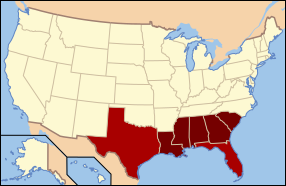
The concept of the "Deep South" solidified in the mid-19th century, specifically around the secession of Southern states. Its historical identity is inextricably linked to the antebellum plantation economy, which was heavily dependent on enslaved African labor. States like Mississippi and South Carolina had the highest proportions of enslaved people, making them the most fervent proponents of slavery and states' rights. Following the Civil War and the subsequent Reconstruction, the region grappled with the abolition of slavery and the assertion of civil rights by newly freed African Americans. This period was marked by intense racial conflict, the rise of white supremacist groups like the Ku Klux Klan, and ultimately, the Compromise of 1877, which effectively ended federal oversight and ushered in the Jim Crow era of segregation. The economic and social structures established during these formative years cast a long shadow, shaping the region's trajectory for over a century.
⚙️ Defining Characteristics
What truly defines the Deep South is its unique cultural milieu, forged from a complex interplay of Southern traditions, African American heritage, and the enduring impact of its agrarian past. This is a land where the echoes of the blues and Gospel music resonate as strongly as the traditions of Southern hospitality. The cuisine, characterized by dishes like gumbo, fried chicken, and biscuits and gravy, is a testament to this fusion of influences. Architecturally, antebellum mansions and historic town squares speak to a bygone era, while the pervasive influence of various Christian denominations, particularly Baptist churches, underscores the region's religious character. The distinct dialect, often characterized by a Southern drawl, further contributes to its unique cultural identity, making it a recognizable and often romanticized, yet also contested, part of the American mosaic.
📊 Key Facts & Numbers
Several key figures and institutions are central to understanding the Deep South. Jefferson Davis, the president of the Confederate States of America, is a pivotal, albeit controversial, historical figure. Martin Luther King Jr., a leader of the Civil Rights Movement, delivered some of his most impactful speeches in cities like Birmingham and Selma, challenging the region's entrenched segregation. Institutions like Tulane University in New Orleans and the University of Georgia in Athens have long been centers of higher learning and cultural influence. The Southern Poverty Law Center, based in Montgomery, Alabama, plays a critical role in monitoring and combating hate groups and extremism that have historically plagued the region. The Mississippi River itself, a vital artery for commerce and culture, has shaped the development of states like Louisiana and Mississippi.
👥 Key Figures & Institutions
The cultural output of the Deep South has had a profound and lasting impact on American and global culture. Artists like Robert Johnson, Elvis Presley, and Aretha Franklin emerged from this soil, their music carrying the stories and struggles of the region. Southern literature, with giants like William Faulkner, Flannery O'Connor, and Tennessee Williams, has explored the region's complexities with unflinching honesty. The region's distinct culinary traditions have also gained national and international acclaim, with Southern food becoming a celebrated, albeit sometimes debated, aspect of American identity. The enduring imagery of the Deep South, from its antebellum architecture to its sprawling plantations, continues to be a potent force in film and literature.
🌍 Cultural Impact & Influence
In the 21st century, the Deep South is a region in flux, navigating its complex past while embracing new economic and social realities. Cities like Atlanta have emerged as major economic and cultural hubs, attracting diverse populations and fostering innovation in technology and entertainment. While the region still grapples with issues of racial inequality and political polarization, there are also signs of progress. The tourism industry, capitalizing on the region's rich history and cultural attractions, continues to grow, drawing visitors interested in everything from Civil Rights landmarks to New Orleans' vibrant music scene. The ongoing debates surrounding Confederate monuments and historical memory highlight the region's continuous engagement with its legacy.
⚡ Current State & Latest Developments
The Deep South is a region rife with controversy, primarily stemming from its historical entanglement with slavery and racial oppression. The continued presence and debate surrounding Confederate monuments across the region exemplify this tension, with ongoing legal and social battles over their removal. The legacy of Jim Crow laws and systemic racism continues to manifest in disparities in wealth, education, and the justice system, sparking persistent activism and calls for reform. Furthermore, the region's conservative political leanings and its role in national political debates, particularly concerning issues of voting rights and social policies, often place it at the center of national controversy. The economic disparities between the Deep South and other regions of the United States also fuel ongoing debates about regional development and equitable resource distribution.
🤔 Controversies & Debates
The future of the Deep South will likely be defined by its ongoing negotiation with its past and its adaptation to demographic and economic shifts. As the region becomes more diverse, particularly with growing Latino and Asian populations in urban centers, its cultural and political landscape is poised for further evolution. The economic diversification away from traditional industries like agriculture could lead to greater prosperity, but also raises questions about equitable development and the potential for new forms of inequality. The region's role in national politics will continue to be significant, with its voting patterns and social movements influencing broader trends. Ultimately, the Deep South's future hinges on its ability to confront its historical injustices while harnessing its unique cultural strengths to build a more inclusive and prosperous society for all its residents.
🔮 Future Outlook & Predictions
While the Deep South is primarily a cultural and geographic designation, its influence is felt across various practical applications. The region's rich musical heritage, particularly blues and jazz, has provided the foundational elements for countless genres worldwide, influencing artists from The Beatles to Beyoncé.
Key Facts
- Category
- culture
- Type
- topic