
Contents
Overview
The conceptual seeds of decoherence were sown in the early days of quantum mechanics, particularly in the discussions surrounding the measurement problem and the interpretation of quantum theory. Physicists like Erwin Schrödinger, in his famous thought experiment involving a cat, highlighted the perplexing nature of quantum superposition. Their work sought to explain how the seemingly deterministic classical world emerges from underlying quantum probabilities, proposing that interactions with the environment effectively 'select' a classical outcome by destroying quantum coherence. Early experimental efforts, though not explicitly framed as decoherence studies, laid the groundwork for later investigations into quantum state decay.
⚙️ How It Works
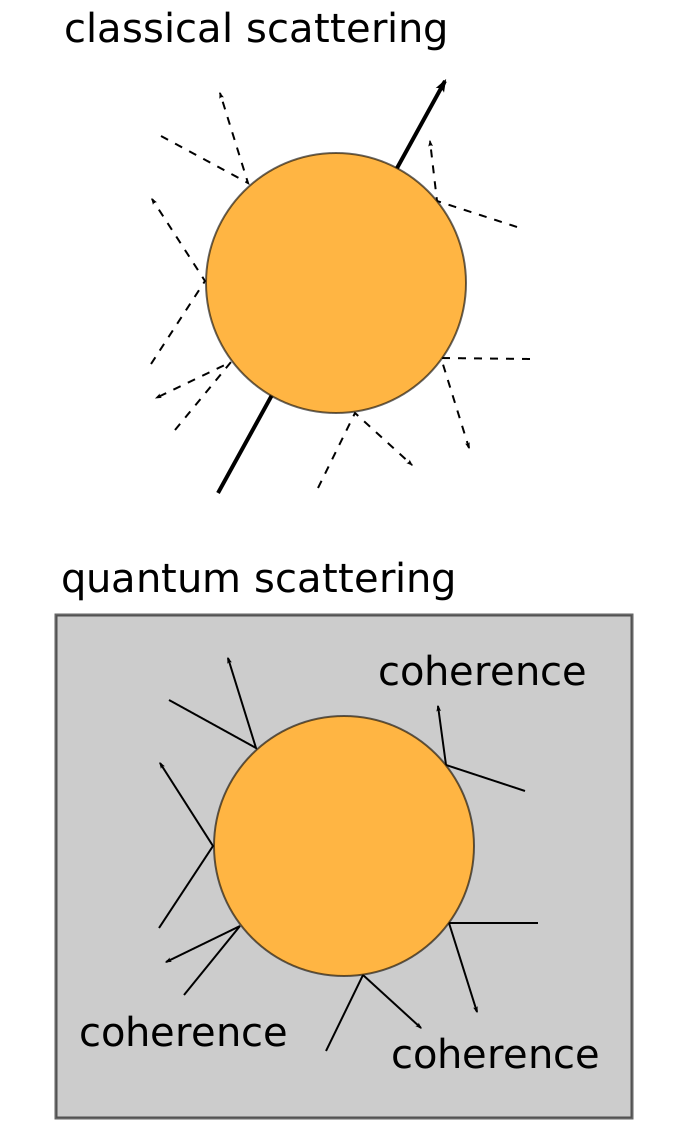
At its heart, decoherence is an entanglement-driven process. A quantum system, initially in a pure quantum state (like a superposition of states), interacts with its surrounding environment, which can be anything from stray photons to thermal vibrations. This interaction causes the system and its environment to become entangled. Because the environment is typically vast and complex, its states are not precisely tracked, and its entanglement with the system effectively 'leaks' quantum information into the environment. From the perspective of the system alone, this loss of information manifests as a loss of coherence, leading to a probabilistic mixture of classical states rather than a quantum superposition. This process is often described mathematically using the density matrix formalism, where the off-diagonal elements representing coherence decay over time.
📊 Key Facts & Numbers
The rate of decoherence is astonishingly rapid for macroscopic objects. A macroscopic object like a grain of dust experiences decoherence on timescales far shorter than the age of the universe, effectively preventing it from exhibiting quantum superposition. For instance, experiments have demonstrated that even a single photon interacting with a photodetector can lead to decoherence within picoseconds. The fidelity of quantum states, a measure of how well a quantum state is preserved, can drop from near 100% to below 50% due to decoherence in mere nanoseconds for certain experimental setups.
👥 Key People & Organizations
Pioneering figures in decoherence research include Wojciech H. Zurek, whose work provided a robust theoretical framework for understanding decoherence as a consequence of environmental interactions. E. Joakim Khalili and H. Dieter Zeiger also made seminal contributions to the theoretical development and experimental verification of decoherence. More recently, researchers at institutions like MIT, Caltech, and the Max Planck Society are pushing the boundaries of maintaining coherence for longer durations in systems like trapped ions and superconducting circuits. Organizations like the National Science Foundation and the European Research Council fund much of this cutting-edge research.
🌍 Cultural Impact & Influence
Decoherence is the unsung hero (or villain, depending on your perspective) behind the quantum-to-classical transition. It's the reason why the probabilistic, superposition-laden world of quantum mechanics appears so alien compared to our everyday experience. Culturally, this concept has seeped into science fiction, often serving as a narrative device to explain why fantastical quantum phenomena remain confined to the microscopic realm. The philosophical implications are profound, touching on the nature of reality, observation, and the role of the observer in shaping quantum outcomes, a debate that has echoed since the early days of Copenhagen interpretation of quantum mechanics.
⚡ Current State & Latest Developments
Current research focuses on mitigating decoherence in quantum computing architectures and exploring its role in complex quantum phenomena. Scientists are developing novel error-correction codes and designing hardware that shields qubits from environmental noise more effectively. For instance, advancements in cryogenic engineering are enabling longer coherence times for superconducting qubits by maintaining ultra-low temperatures. Simultaneously, researchers are investigating decoherence in biological systems, exploring whether quantum effects play a role in processes like photosynthesis or avian navigation, a field that remains highly speculative but actively researched.
🤔 Controversies & Debates
A central debate revolves around whether decoherence fully resolves the measurement problem in quantum mechanics. While decoherence explains the loss of quantum interference, critics argue it doesn't fully account for the emergence of a single, definite outcome from the probabilistic quantum state. Some interpretations, like the many-worlds interpretation, propose that all outcomes occur in separate universes, thus avoiding the need for a collapse. Others, like objective collapse theories, suggest a physical mechanism for wave function collapse that is independent of an observer. The practical challenge of achieving fault-tolerant quantum computation, which requires overcoming decoherence, also fuels ongoing debate about the feasibility and timeline of large-scale quantum computers.
🔮 Future Outlook & Predictions
The future of decoherence research is inextricably linked to the advancement of quantum technologies. For quantum computing, the goal is to push coherence times into the realm of minutes or even hours, enabling complex algorithms to run without succumbing to errors. This could unlock breakthroughs in drug discovery, materials science, and cryptography. Beyond computing, understanding decoherence might shed light on fundamental questions about gravity and the early universe. Researchers are also exploring 'engineered decoherence' as a tool for quantum simulation and for probing the boundaries between quantum and classical physics, potentially leading to new forms of computation or sensing.
💡 Practical Applications
The most significant practical application of understanding decoherence is in the development of quantum computers. By actively combating decoherence through techniques like quantum error correction and improved shielding, scientists aim to build machines capable of solving problems intractable for classical computers. Decoherence also plays a role in quantum sensing, where precise measurements of magnetic fields or time can be achieved by carefully controlling quantum states and their interaction with the environment. Furthermore, understanding decoherence is crucial for developing secure quantum communication networks, ensuring that quantum key distribution remains robust against eavesdropping.
Key Facts
- Category
- science
- Type
- concept