
Contents
Overview
The roots of cybersecurity for defense are as old as warfare itself, evolving from the need to protect sensitive military communications and intelligence. Early forms involved physical security of telegraph lines and cryptographic methods like the Enigma machine used by Germany in World War II. The advent of computers in military operations during the Cold War introduced new vulnerabilities, leading to the development of early network security protocols and intrusion detection systems by organizations like the U.S. Department of Defense in the 1970s and 1980s. The rise of the Internet and networked warfare in the late 20th and early 21st centuries dramatically expanded the threat surface, forcing a more sophisticated and integrated approach to digital defense, with nations like Russia and China emerging as significant state-sponsored cyber actors. The establishment of dedicated cyber commands, such as U.S. Cyber Command in 2009, marked a formal recognition of cyber as a distinct domain of warfare.
⚙️ How It Works
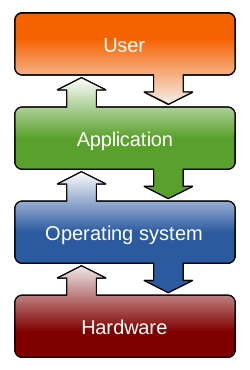
Cybersecurity for defense operates on multiple layers, from the physical security of hardware to the complex algorithms protecting software and data. At the foundational level, it involves securing networks with firewalls, VPNs, and robust access control mechanisms to prevent unauthorized entry. Encryption is paramount, safeguarding classified data both in transit and at rest, often employing AES or TLS protocols. Intrusion detection and prevention systems (IDPS) continuously monitor network traffic for malicious patterns, while SIEM systems aggregate and analyze security logs from across disparate systems. Furthermore, defense cybersecurity incorporates human elements through rigorous security awareness training for personnel and strict adherence to information assurance policies, ensuring that even the most sophisticated technical defenses are not undermined by human error or malicious intent.
📊 Key Facts & Numbers
The global defense cybersecurity market is a colossal enterprise. The United States alone accounts for over 40% of this market share. Military branches are investing heavily; for instance, the U.S. Navy allocated over 3 billion USD to cybersecurity initiatives in its 2023 budget. Nation-state attacks are a constant threat, with estimates suggesting that state-sponsored groups conduct millions of cyberattacks annually against defense targets. The average cost of a single significant cyber breach for a defense contractor can range from 1 million USD to over 10 million USD, impacting operational readiness and national security.
👥 Key People & Organizations
Key players in defense cybersecurity include government entities, specialized defense contractors, and leading technology firms. Government bodies like the NSA in the U.S., GCHQ in the UK, and BND in Germany set standards and conduct offensive/defensive cyber operations. Major defense contractors such as Lockheed Martin, Northrop Grumman, and BAE Systems develop and implement secure systems for military clients. Technology giants like Microsoft, Google, and AWS are increasingly involved, providing cloud infrastructure and cybersecurity solutions tailored for defense applications. Think tanks and research institutions like the RAND Corporation also play a crucial role in shaping policy and understanding emerging threats.
🌍 Cultural Impact & Influence
Cybersecurity for defense has profoundly shaped military doctrine and international relations. The concept of cyberwarfare has entered public consciousness, influencing everything from geopolitical strategy to popular culture, as seen in fictional portrayals of digital conflicts in films like WarGames and series like Mr. Robot. The constant threat of cyberattacks has fostered a global landscape of digital espionage and deterrence, akin to nuclear deterrence during the Cold War. It has also spurred international cooperation and conflict, with nations forming alliances to share threat intelligence while simultaneously engaging in covert digital operations against adversaries. The very definition of national security has expanded to include the digital realm, impacting diplomatic efforts and defense budgets worldwide.
⚡ Current State & Latest Developments
The current landscape of defense cybersecurity is defined by an escalating arms race, particularly in the realm of AI and machine learning. Adversaries are leveraging AI for more sophisticated malware development, automated phishing attacks, and advanced persistent threats (APTs) targeting critical defense infrastructure. Nations are rapidly integrating AI into their defensive capabilities for faster threat detection, automated response, and predictive analytics. The war in Ukraine has served as a real-world testbed for advanced cyber capabilities, showcasing the impact of disinformation campaigns, DDoS attacks, and the use of cyber tools for intelligence gathering and operational disruption. Furthermore, the increasing reliance on cloud computing for military operations introduces new complexities in securing distributed systems and sensitive data, with entities like Palantir Technologies developing platforms for defense data integration and analysis.
🤔 Controversies & Debates
Significant controversies surround defense cybersecurity, particularly concerning offensive cyber operations and the ethics of state-sponsored hacking. The development and deployment of offensive cyber weapons, such as Stuxnet, raise questions about escalation, attribution, and the potential for unintended consequences. Debates also rage over the balance between national security and privacy rights, especially concerning government surveillance capabilities and data collection on citizens and foreign entities. The increasing use of private military companies and contractors in cyber defense roles also introduces accountability challenges. Furthermore, the question of whether cyber warfare constitutes a 'real' act of war, triggering Article 5 of NATO, remains a subject of intense debate among international legal scholars and policymakers.
🔮 Future Outlook & Predictions
The future of defense cybersecurity will be dominated by the pervasive integration of quantum computing and advanced AI. Quantum computing poses a dual threat: it could break current encryption standards, necessitating the development of post-quantum cryptography, while also enabling new forms of secure communication. AI will become even more critical for both offense and defense, leading to autonomous cyber weapons and highly sophisticated AI-driven defense systems capable of self-healing and adaptive protection. The concept of the cyber-physical system will blur the lines between the digital and physical domains further, meaning cyberattacks could have direct, kinetic impacts on critical infrastructure and military platforms. Expect a continued arms race in zero-day exploits and a greater emphasis on resilience and zero-trust architecture principles across all military networks.
💡 Practical Applications
Cybersecurity for defense has direct practical applications across the entire spectrum of military operations. This includes securing command and control systems to ensure leaders can issue and receive orders reliably, protecting ISR platforms to prevent adver
Key Facts
- Category
- technology
- Type
- topic