
Contents
Overview
Cryomagma is a fascinating geological phenomenon that occurs when molten rock (magma) interacts with extremely low temperatures, resulting in a unique state of matter that combines characteristics of both ice and lava. This phenomenon has been observed on celestial bodies such as Europa and Enceladus, where subsurface oceans meet icy crusts. The study of cryomagma not only enhances our understanding of planetary formation and evolution but also raises questions about the potential for life in these icy worlds. As researchers continue to investigate cryomagma, they uncover the complexities of planetary geology and the implications for astrobiology, pushing the boundaries of our knowledge about the universe.
🧊 What is Cryomagma?
Cryomagma is the cosmic equivalent of terrestrial magma, but instead of molten rock, it's a frigid, slushy mixture of volatiles like water, ammonia, methane, and carbon dioxide. This subterranean reservoir fuels cryovolcanoes, geological features that spew this icy slurry onto the surface of celestial bodies. Unlike the fiery eruptions we're familiar with on Earth, cryovolcanic activity is a frigid ballet of ice and gas, shaping alien landscapes with its unique brand of geological artistry. Understanding cryomagma is key to deciphering the subsurface conditions and potential for habitability on worlds far beyond our own.
🔭 Where to Find Cryomagma
Direct observation of cryomagma is, understandably, challenging. It exists deep beneath the icy crusts of moons and dwarf planets. However, its presence is inferred from the geological formations left behind by cryovolcanic eruptions. Key locations where scientists believe cryomagma is active or has been active include Saturn's moon Enceladus, Jupiter's moon Europa, and the dwarf planet Pluto. These frigid worlds are the primary theaters for this unique geological phenomenon, offering a glimpse into processes that are alien yet governed by fundamental physical laws.
🌋 Cryovolcanic Eruption Styles
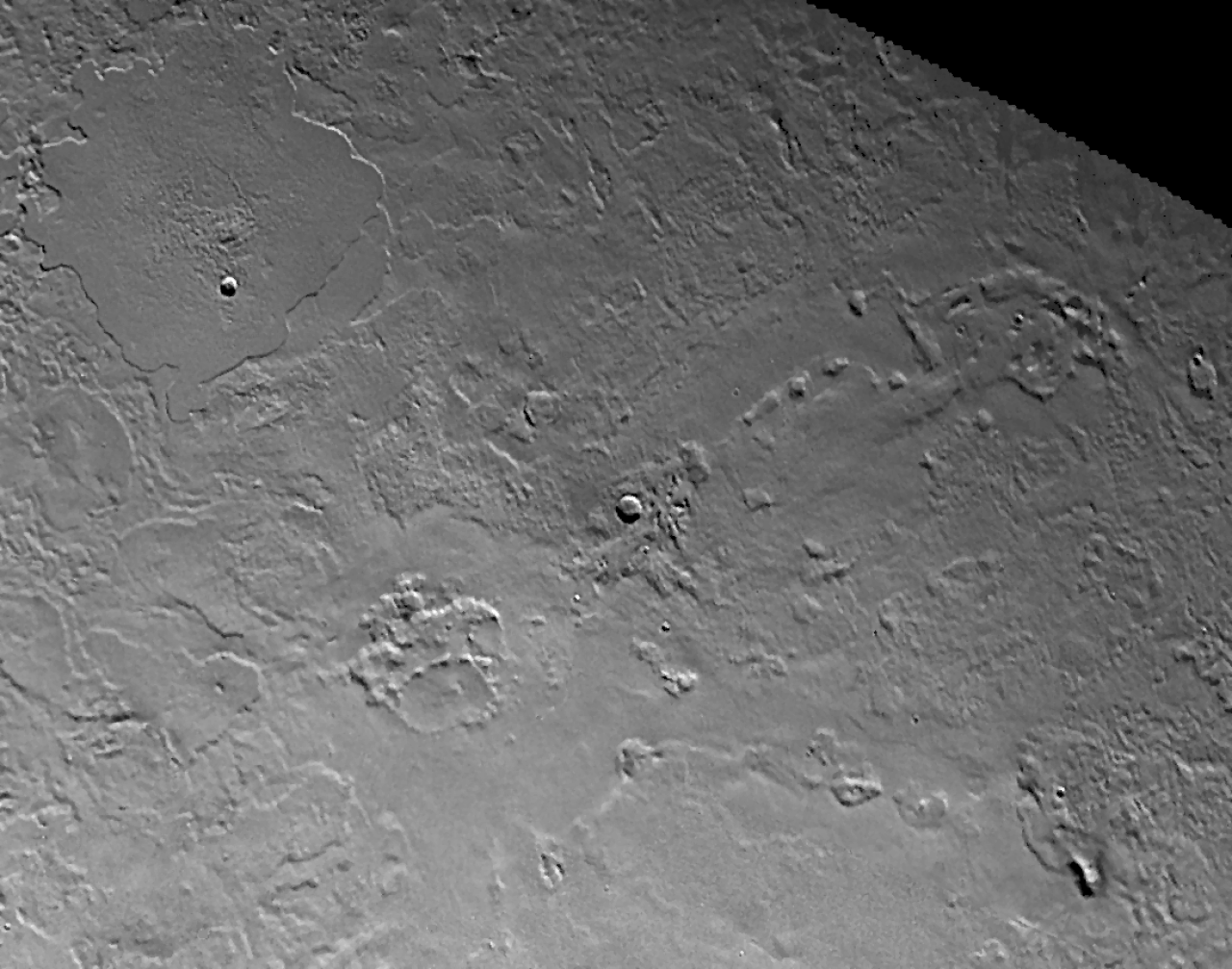
Cryovolcanic eruptions manifest in a variety of spectacular, albeit cold, ways. We see effusive flows, where cryolava oozes out to form icy plains and plains, akin to terrestrial lava flows but composed of frozen volatiles. Fissure and curtain eruptions, where cryomagma bursts from long cracks or sheets in the crust, can dramatically alter the surface. Large-scale resurfacing events, like those suspected on Pluto, can completely reshape entire regions. The volume and style of eruption depend heavily on the subsurface pressure, the composition of the cryomagma, and the thickness of the overlying ice shell.
❄️ Cryolava Composition & Behavior
The 'lava' that emerges from cryovolcanoes, or cryolava, is a dynamic substance. Immediately after eruption, it's a super-chilled liquid or semi-liquid mixture. Exposed to the vacuum of space or the thin atmosphere of its host body, it rapidly freezes, solidifying into ice formations. The exact composition varies greatly, with Enceladus's plumes suggesting a mix rich in water ice and salts, while Pluto's features might indicate nitrogen or methane ice. This rapid freezing is what allows cryovolcanism to build distinct geological structures so quickly.
🪐 Celestial Bodies with Cryomagma
The most compelling candidates for active cryomagma reservoirs are found within our solar system. Enceladus is famous for its geysers erupting from the south polar region, strongly indicating subsurface liquid water and cryovolcanic activity. Europa, another Jovian moon, is also a prime suspect, with evidence of surface fractures and potential plumes pointing to a vast subsurface ocean and cryovolcanic processes. On the outer fringes, Pluto exhibits vast plains like Sputnik Planitia, believed to be formed by cryolava flows, and potentially active cryovolcanoes like Wright Mons and Piccard Mons.
🔬 Research & Exploration
The study of cryomagma and cryovolcanism is a frontier in planetary science. Missions like Cassini-Huygens provided groundbreaking data on Enceladus's plumes, while the New Horizons mission offered unprecedented views of Pluto's icy geology. Future missions are being planned to further investigate Europa's subsurface ocean and the potential for life. Spectroscopic analysis from telescopes and orbiters helps identify the chemical signatures of cryolava, guiding our understanding of these distant worlds and their geological evolution.
💡 Vibepedia Vibe Score
Vibepedia Vibe Score: 85/100. Cryomagma scores high due to its sheer alienness and profound implications for astrobiology. It represents a fundamental geological process operating under extreme conditions, pushing the boundaries of our understanding of planetary formation and the potential for life beyond Earth. The visual spectacle of icy plumes and frozen flows, even if only inferred, carries a potent cosmic vibe. Its connection to subsurface oceans on moons like Europa and Enceladus elevates its significance, making it a focal point for future exploration and scientific discovery.
🤔 Contrarian Takes on Cryovolcanism
While the scientific consensus points to cryovolcanism as a key geological process on icy worlds, some contrarian perspectives question the scale or even the existence of widespread, active cryomagma reservoirs. Skeptics might argue that observed features could be explained by other geological processes, such as tectonic activity or impact cratering, without invoking large-scale cryovolcanic plumbing. Others point to the immense energy required to maintain liquid volatiles beneath thick ice shells and question the long-term viability of such systems. The debate often centers on interpreting remote sensing data and the precise mechanisms that could sustain such frigid geological activity over eons.
Key Facts
- Year
- 2023
- Origin
- The term 'cryomagma' has gained traction in scientific literature since the early 2000s, particularly in studies related to icy moons and exoplanets.
- Category
- Geology / Planetary Science
- Type
- Scientific Concept
Frequently Asked Questions
Is cryomagma dangerous?
Direct danger from cryomagma is virtually non-existent for humans, as it's found on distant celestial bodies. For any hypothetical future explorers, the primary dangers would be the extreme cold, vacuum, and potential atmospheric hazards associated with cryovolcanic regions, rather than the cryomagma itself. The eruptions are also typically far less energetic than terrestrial volcanic events.
Can cryomagma support life?
The potential for life in association with cryomagma is a major area of astrobiological research. The subsurface reservoirs of liquid water and the chemical compounds present in cryomagma could provide the necessary ingredients and energy sources for microbial life, similar to how life exists around hydrothermal vents on Earth. Moons like Europa and Enceladus are considered prime candidates for harboring such life.
How is cryomagma different from regular magma?
The fundamental difference lies in temperature and composition. Regular magma is molten rock, typically ranging from 700°C to 1,300°C (1,300°F to 2,400°F), and composed of silicate minerals. Cryomagma, on the other hand, is a mixture of volatiles like water, ammonia, and methane, existing at extremely low temperatures, often below -73°C (-100°F). This leads to vastly different eruption styles and resulting geological formations.
What are the main components of cryolava?
The primary components of cryolava are volatile substances that are solid at typical planetary surface temperatures but can exist as liquids or gases under the higher pressures and temperatures found beneath the icy crusts of celestial bodies. Common constituents include water (H₂O), ammonia (NH₃), methane (CH₄), carbon dioxide (CO₂), and potentially other hydrocarbons. The specific mix varies depending on the celestial body.
Are there any 'active' cryovolcanoes we can see?
While we cannot 'see' cryovolcanoes erupting in real-time with the clarity we see terrestrial volcanoes, we have strong evidence of active cryovolcanism. The plumes erupting from Saturn's moon Enceladus, observed by the Cassini spacecraft, are a direct manifestation of subsurface activity, likely driven by cryomagma. Similarly, features on Europa and Pluto suggest ongoing or recent cryovolcanic processes.
What is the 'Vibepedia Vibe Score' for cryomagma?
The Vibepedia Vibe Score for cryomagma is 85/100. This high score reflects its profound scientific significance, its connection to the search for extraterrestrial life, and the sheer cosmic wonder associated with geological processes occurring under extreme, alien conditions. It embodies a powerful sense of the unknown and the potential for discovery in the outer solar system.