
Contents
Overview
The concept of cell division, while seemingly obvious now, was a profound discovery that reshaped our understanding of life. Early microscopists observed cells in the 17th century, but the dynamic process of division remained elusive. It wasn't until the mid-19th century that scientists began to systematically document this phenomenon. The concept of cell theory was established, positing that all living things are composed of cells, but the mechanism of cell creation was still debated. The idea that all cells arise from pre-existing cells was solidified. The distinct processes of mitosis and meiosis were gradually elucidated through the work of researchers who provided detailed descriptions of chromosome behavior during division and linked chromosome behavior to heredity.
⚙️ How It Works
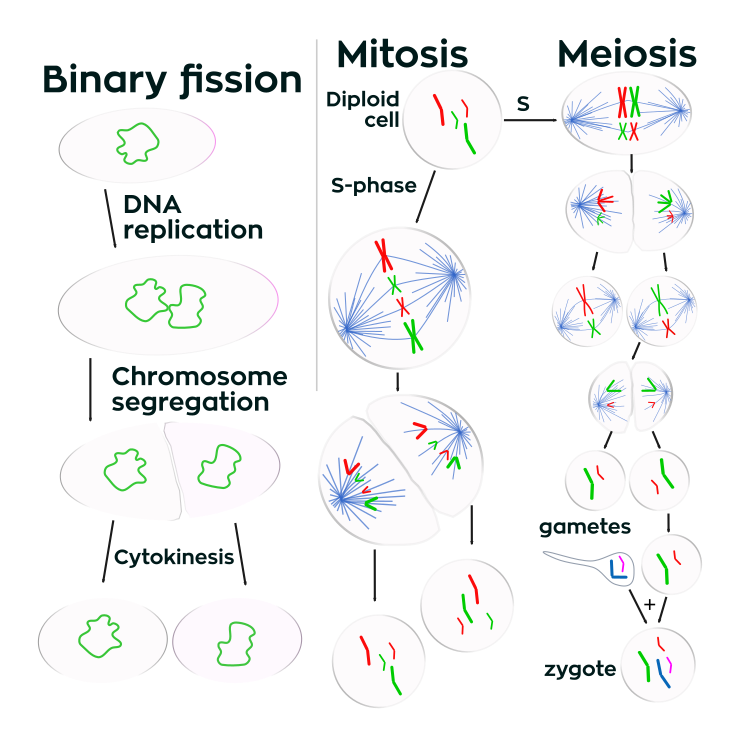
Cell division is a meticulously orchestrated dance of molecular machinery. In eukaryotes, the process typically begins with interphase, a preparatory stage where the cell grows and duplicates its DNA. The subsequent phase, the M phase, involves mitosis and cytokinesis. Mitosis itself is further divided into prophase, metaphase, anaphase, and telophase. During metaphase, chromosomes align at the cell's equator, forming the metaphase plate. During anaphase, sister chromatids are pulled apart to opposite poles of the cell. Cytokinesis is the physical division of the cytoplasm, typically overlapping with telophase, resulting in two distinct daughter cells, each with a complete set of chromosomes. Prokaryotes, lacking a nucleus, divide via a simpler process called binary fission.
📊 Key Facts & Numbers
The sheer scale of cell division is staggering. The human genome, comprising approximately 3 billion base pairs, is accurately replicated during each cell cycle, with error rates as low as 1 in a billion. The human gut lining is completely replaced every 3-5 days, requiring an estimated 100 billion cell divisions per day. Red blood cells, with a lifespan of about 120 days, are produced at a rate of roughly 2.4 million per second. For instance, a single-celled organism like E. coli can divide every 20 minutes under optimal conditions, leading to exponential population growth. A single bacterium could theoretically produce over a trillion descendants in just 24 hours. A typical human body contains an estimated 30-40 trillion cells, and trillions of new cells are produced daily to replace old or damaged ones.
👥 Key People & Organizations
The study of cell division has been advanced by numerous pivotal figures and institutions. Walther Flemming provided detailed descriptions of chromosome behavior during division in the late 19th century. Theodor Boveri and Walter Sutton developed the chromosome theory of inheritance, linking the behavior of chromosomes during meiosis to the transmission of traits. James Watson and Francis Crick, though primarily known for discovering the structure of DNA, laid the groundwork for understanding DNA replication, a prerequisite for cell division. Key institutions like the Max Planck Institutes in Germany and the Howard Hughes Medical Institute in the United States have consistently funded cutting-edge research in cell biology and genetics, fostering breakthroughs in our understanding of cell division.
🌍 Cultural Impact & Influence
Cell division's influence permeates our culture and understanding of life. The concept of cellular reproduction is fundamental to biological education, appearing in textbooks from elementary school to advanced university courses. It forms the basis for understanding development, from the single-celled zygote to a complex organism, and is central to discussions of disease, particularly cancer, which is characterized by uncontrolled cell division. The visual representation of dividing cells, with their distinct stages and chromosome movements, has become iconic in scientific imagery. Furthermore, the ethical debates surrounding stem cell research and IVF are intrinsically linked to the manipulation and understanding of cell division processes.
⚡ Current State & Latest Developments
Current research in cell division is pushing the boundaries of our knowledge, particularly in understanding its role in disease and aging. Scientists are intensely focused on the molecular checkpoints that regulate the cell cycle, aiming to identify new therapeutic targets for cancer therapy. Research into cellular senescence, a state where cells stop dividing, is exploring its implications for aging and age-related diseases. Advances in live-cell imaging techniques, such as fluorescence microscopy, allow researchers to observe cell division in real-time with unprecedented detail, revealing subtle regulatory mechanisms. The study of asymmetric cell division is also gaining traction, investigating how cells can produce daughter cells with different fates, crucial for development and tissue homeostasis.
🤔 Controversies & Debates
While the fundamental mechanisms of mitosis and meiosis are well-established, several controversies and debates persist. One significant area of contention revolves around the precise regulation of cell cycle checkpoints and the role of specific genes in preventing uncontrolled proliferation. The exact mechanisms by which errors in chromosome segregation, known as aneuploidy, contribute to developmental disorders and cancer are still being actively investigated. Furthermore, the ethical implications of manipulating cell division, particularly in the context of embryonic stem cell research and gene editing technologies like CRISPR-Cas9, remain a subject of intense global debate. The potential for off-target effects and the long-term consequences of altering fundamental cellular processes are subjects of ongoing scientific and societal discussion.
🔮 Future Outlook & Predictions
The future of cell division research promises revolutionary advancements. A major focus will be on developing highly targeted therapies for diseases driven by aberrant cell division, such as various forms of cancer. This includes personalized medicine approaches that tailor treatments based on the specific cell division defects in a patient's tumor. Researchers are also exploring the potential of regenerative medicine to harness controlled cell division for tissue repair and organ regeneration, potentially addressing organ shortages. Understanding the interplay between cell division and the microbiome is another emerging frontier, investigating how microbial communities might influence host cell division. Furthermore, advancements in artificial intelligence and machine learning are expected to accelerate the discovery of new regulatory pathways and therapeutic targets by analyzing vast datasets generated from cellular studies.
💡 Practical Applications
Cell division is not just a theoretical concept; it has profound practical applications. In medicine, understanding cell division is crucial for developing chemotherapy drugs that target rapidly dividing cancer cells, though
Key Facts
- Category
- science
- Type
- topic