
Contents
- 🎵 Origins & History
- ⚙️ How It Works
- 📊 Key Facts & Numbers
- 👥 Key People & Organizations
- 🌍 Cultural Impact & Influence
- ⚡ Current State & Latest Developments
- 🤔 Controversies & Debates
- 🔮 Future Outlook & Predictions
- 💡 Practical Applications
- 📚 Related Topics & Deeper Reading
- Frequently Asked Questions
- References
- Related Topics
Overview
The genesis of the ballistic missile can be traced back to the V-2 rocket, developed by Nazi Germany during World War II under the leadership of Wernher von Braun at the Peenemünde Army Research Center. This groundbreaking weapon, first launched in October 1942, demonstrated the potential of liquid-fueled rockets for military purposes, reaching altitudes of over 80 kilometers and traveling hundreds of kilometers. Following the war, both the United States and the Soviet Union aggressively pursued V-2 technology and personnel, initiating a fierce arms race. The U.S. captured von Braun and his team, integrating them into their own missile programs, such as the Redstone missile, while the Soviets, under the direction of Sergei Korolev, developed their own lineage of ballistic missiles, culminating in the R-7 Semyorka, which famously launched Sputnik in 1957. This early period was characterized by rapid, often clandestine, development, laying the foundation for the strategic nuclear arsenals of the Cold War.
⚙️ How It Works
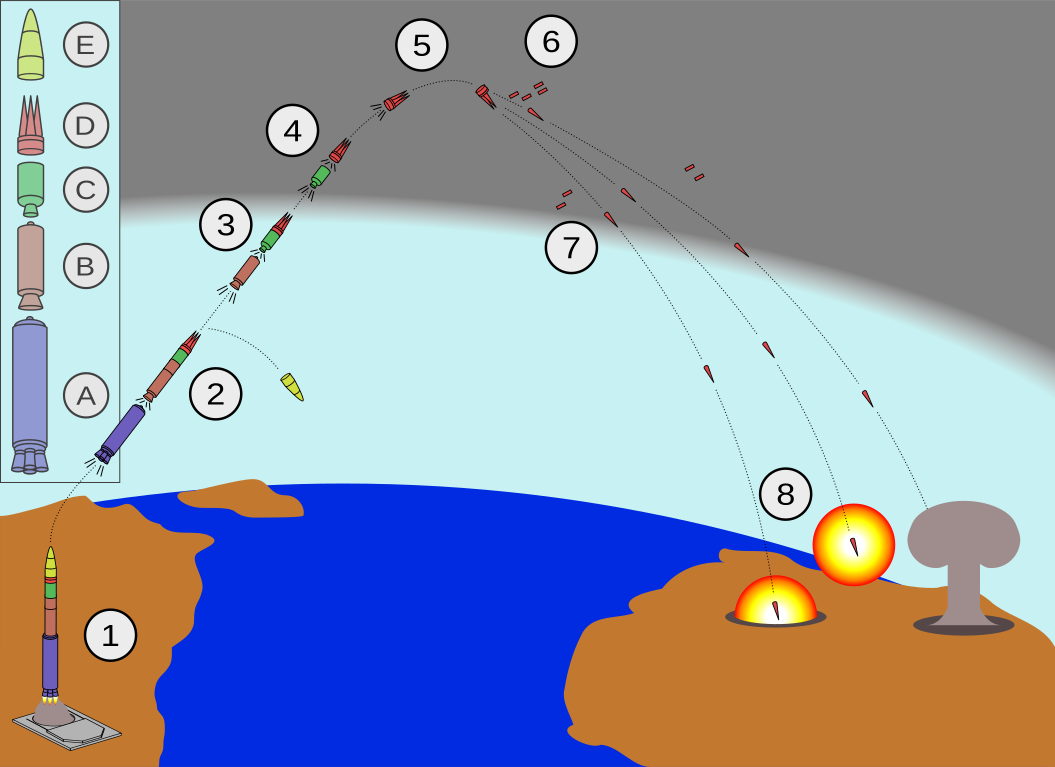
A ballistic missile operates in distinct phases. First, the boost phase, where powerful rocket engines propel the missile upward and impart the necessary velocity and trajectory. This phase typically lasts only a few minutes, during which the missile exits the dense lower atmosphere. Following engine cutoff, the missile enters the mid-course phase, where it travels unpowered along a ballistic trajectory, largely unaffected by atmospheric drag. This is the longest phase, during which the missile can reach altitudes well above the Earth's atmosphere, even entering sub-orbital space. Finally, the terminal phase involves the warhead(s) re-entering the atmosphere and descending towards the target. Advanced ballistic missiles employ sophisticated guidance systems, including inertial navigation systems (INS) and sometimes GPS, to refine their trajectory and ensure accuracy, especially for multiple independently targetable re-entry vehicles (MIRVs).
📊 Key Facts & Numbers
The global inventory of ballistic missiles is staggering, with estimates suggesting over 10,000 warheads deployed across nine nations as of 2023. Intercontinental Ballistic Missiles (ICBMs), capable of ranges exceeding 5,500 kilometers, form the backbone of strategic nuclear deterrence for major powers like the United States, Russia, and China. The U.S. operates Minuteman III ICBMs, while Russia fields systems like the Yars and Topol-M. North Korea has rapidly advanced its capabilities, reportedly possessing missiles with ranges capable of reaching the U.S. mainland. The cost of developing and maintaining these arsenals is astronomical, with annual global military spending on nuclear weapons alone estimated to be in the tens of billions of dollars. The development of solid-fuel rocket motors, first widely deployed in the U.S. Polaris submarine-launched ballistic missile (SLBM) in the late 1950s, significantly improved reliability and readiness.
👥 Key People & Organizations
Key figures in ballistic missile development include Wernher von Braun, the German rocket scientist who became a pivotal figure in the U.S. space and missile programs, and Sergei Korolev, the Soviet chief designer whose work was instrumental in the Soviet missile and space achievements. Major organizations driving this technology are national defense ministries and their associated research and development agencies, such as Lockheed Martin and Boeing in the United States, Roscosmos (formerly the Soviet space program) in Russia, and the China Aerospace Science and Technology Corporation (CASC) in China. The United Nations and various international bodies also play a crucial role in monitoring and regulating ballistic missile proliferation through treaties like the Missile Technology Control Regime (MTCR).
🌍 Cultural Impact & Influence
Ballistic missiles have profoundly shaped global culture and consciousness, primarily through the existential threat they represent. The doctrine of Mutually Assured Destruction (MAD), a direct consequence of the proliferation of nuclear-armed ballistic missiles, became a defining feature of the Cold War era, influencing everything from political discourse to Hollywood blockbusters like Dr. Strangelove. The iconic imagery of missile silos, launch sequences, and mushroom clouds became potent symbols of technological power and potential annihilation. Furthermore, the underlying rocket technology, pioneered for military purposes, directly enabled the Space Race and continues to underpin modern space exploration and satellite deployment, demonstrating a complex duality of destructive and constructive potential.
⚡ Current State & Latest Developments
The current landscape of ballistic missile technology is marked by rapid modernization and proliferation. Major powers are investing heavily in upgrading their ICBM and SLBM arsenals, focusing on enhanced accuracy, survivability, and the deployment of multiple independently targetable re-entry vehicles (MIRVs). Russia's development of hypersonic glide vehicles, which can be launched from ballistic missiles and maneuver unpredictably, represents a significant challenge to existing missile defense systems. North Korea continues its ballistic missile program, conducting frequent tests of short, medium, and potentially intercontinental-range missiles, raising regional tensions. India and Pakistan maintain their ballistic missile capabilities, underscoring the global reach of this technology. The ongoing development of advanced missile defense systems by countries like the U.S. and Israel also fuels a continuous cycle of innovation and counter-innovation.
🤔 Controversies & Debates
The development and deployment of ballistic missiles are fraught with controversy. The primary debate centers on their role in nuclear deterrence versus their destabilizing potential. Critics argue that the sheer destructive power and the possibility of accidental or unauthorized launch make them inherently dangerous, advocating for complete disarmament. Proponents, however, maintain that ballistic missiles, particularly when armed with nuclear warheads, are essential for deterring aggression and maintaining strategic stability, citing the absence of large-scale wars between major powers during the Cold War as evidence. The proliferation of ballistic missile technology to new states, such as North Korea, is a major international concern, as it increases the risk of regional conflicts escalating into global catastrophes. The development of missile defense systems also sparks debate, with some viewing them as necessary for protection and others as escalatory, potentially undermining existing deterrence frameworks.
🔮 Future Outlook & Predictions
The future of ballistic missiles is likely to be shaped by several key trends. The continued pursuit of hypersonic capabilities, both boost-glide vehicles and hypersonic cruise missiles, will challenge existing defense paradigms. Advances in artificial intelligence and autonomous systems could lead to more sophisticated guidance and targeting, potentially increasing both accuracy and the risk of unintended escalation. The increasing accessibility of space launch technology, driven by private companies like SpaceX, may also blur the lines between military and civilian rocketry, potentially facilitating easier access to missile technology for state and non-state actors. Furthermore, the ongoing geopolitical competition between major powers will likely spur further modernization and the development of novel missile designs, ensuring that ballistic missiles remain a central element of global security discussions for the foreseeable future.
💡 Practical Applications
While primarily known for their military applications, the underlying technology of ballistic missiles has significant practical applications. The rocket propulsion systems developed for ballistic missiles were foundational to the Space Race and continue to power space launch vehicles used by organizations like NASA and SpaceX to deploy satellites, conduct scientific research, and transport astronauts. The guidance and control systems, honed for extreme precision in missile trajectories, have found applications in areas requiring accurate navigation and positioning. Furthermore, the study of atmospheric re-entry and materials science, driven by the need to protect warheads, has contributed to advancements in aerospace engineering and heat-shield technologies used in spacecraft and re-entry capsules. The development of solid rocket motors, for instance, has also been crucial for boosters used in commercial space launches.
Key Facts
- Year
- 1942-present
- Origin
- Germany
- Category
- technology
- Type
- technology
Frequently Asked Questions
What is the fundamental difference between a ballistic missile and a cruise missile?
The core distinction lies in their flight path and propulsion. A ballistic missile is powered only during its initial boost phase, after which it follows an unpowered ballistic trajectory dictated by gravity and momentum, often reaching high altitudes or even space. In contrast, a cruise missile is powered throughout its flight, typically using jet engines, and is aerodynamically guided, allowing it to fly at lower altitudes and maneuver within the atmosphere, much like a pilotless aircraft. This difference in flight profile makes ballistic missiles harder to track during their mid-course phase but predictable once launched, while cruise missiles are more adaptable but can be intercepted by air defenses.
What does 'ballistic trajectory' mean in the context of a missile?
A ballistic trajectory refers to the path an object takes when it is launched and then moves freely under the influence of gravity and air resistance, without any further propulsion. Think of throwing a ball: its arc is a ballistic trajectory. For a ballistic missile, this means after its rocket engines stop firing, it coasts through space or the upper atmosphere, following a predictable curve determined by its initial velocity, launch angle, and the Earth's gravitational pull. This phase constitutes the majority of the missile's flight time.
What are the different classifications of ballistic missiles by range?
Ballistic missiles are typically categorized by their maximum range. Short-Range Ballistic Missiles (SRBMs) have a range of up to 1,000 kilometers. Medium-Range Ballistic Missiles (MRBMs) cover between 1,000 and 3,000 kilometers. Intermediate-Range Ballistic Missiles (IRBMs) have ranges from 3,000 to 5,500 kilometers. Finally, Intercontinental Ballistic Missiles (ICBMs) are designed to travel over 5,500 kilometers, capable of striking targets across continents. Submarine-launched ballistic missiles (SLBMs) are a type of ballistic missile launched from submarines, and can fall into any of these range categories.
How do ballistic missiles achieve such long ranges?
Achieving intercontinental ranges requires immense initial velocity and an optimized trajectory. The powerful rocket engines in the boost phase impart thousands of meters per second of speed, propelling the missile high into the atmosphere and even into the vacuum of space. By launching at a specific angle and achieving sufficient speed, the missile can overcome Earth's gravity sufficiently to coast for thousands of kilometers before re-entering the atmosphere. The trajectory is often a high arc, allowing the missile to travel vast distances before descending on its target. Modern ICBMs can also carry multiple warheads (MIRVs), which separate and follow slightly different trajectories, increasing the difficulty for missile defense systems.
Why are ballistic missiles considered a key component of nuclear deterrence?
Ballistic missiles, particularly ICBMs and SLBMs, are central to nuclear deterrence because they provide a survivable and rapid means of delivering a nuclear payload. Their ability to travel vast distances and their high speeds make them difficult to intercept, ensuring that a retaliatory strike is possible even after a first strike. This capability creates the doctrine of Mutually Assured Destruction (MAD), where any nuclear attack by one superpower would result in devastating retaliation from the other, thus deterring either side from initiating a nuclear conflict. The survivability of land-based ICBMs in hardened silos and mobile launchers, and especially the stealthy nature of submarine-launched missiles, underpins this strategic stability.
What are the main challenges in defending against ballistic missiles?
Defending against ballistic missiles is exceptionally challenging due to their speed, trajectory, and potential for carrying multiple warheads. The mid-course phase, where the missile travels unpowered through space, offers a window for interception, but requires sophisticated tracking and interceptor missiles. However, the terminal phase, as the warhead re-enters the atmosphere at hypersonic speeds, is extremely difficult to counter. Furthermore, advanced missiles can deploy decoys or maneuverable re-entry vehicles (MaRVs) to evade defenses. The sheer number of potential targets and the limited reaction time available also pose significant hurdles for missile defense systems, making complete protection against a large-scale ballistic missile attack currently unfeasible.
What is the role of private companies in ballistic missile technology today?
While ballistic missiles are primarily developed and operated by national governments for military purposes, private companies play a crucial role in advancing the underlying technologies. Companies like SpaceX, Blue Origin, and Rocket Lab are at the forefront of rocket propulsion, guidance systems, and launch infrastructure development. Their innovations in reusable rocket technology, advanced materials, and efficient manufacturing processes can have dual-use applications, potentially influencing the cost and accessibility of missile technology. These companies also contribute to the space launch sector, which relies on similar rocket technologies, and their expertise in satellite deployment is indirectly relevant to the reconnaissance and targeting aspects of missile warfare.