
Contents
Overview
The roots of anamorphic art stretch back to the Renaissance, a period obsessed with perspective and the illusion of depth. While the precise first instance is debated, early examples of distorted projections appear in works like Leonardo da Vinci's 1485 sketch of an eye, which requires a cylindrical mirror to resolve into a face. By the 17th century, artists like Hans Holbein the Younger were masterfully employing anamorphosis, most famously in his 1533 painting The Ambassadors, where a skull looms ominously in the foreground, only becoming clear when viewed from the right side. This technique was not merely an artistic flourish; it served practical and clandestine purposes, allowing artists to embed hidden messages, political commentary, or even erotic imagery that would only be visible to those in on the secret. The development of specialized lenses and mirrors further refined the technique, making it a popular tool for both entertainment and subversion across Europe.
⚙️ How It Works
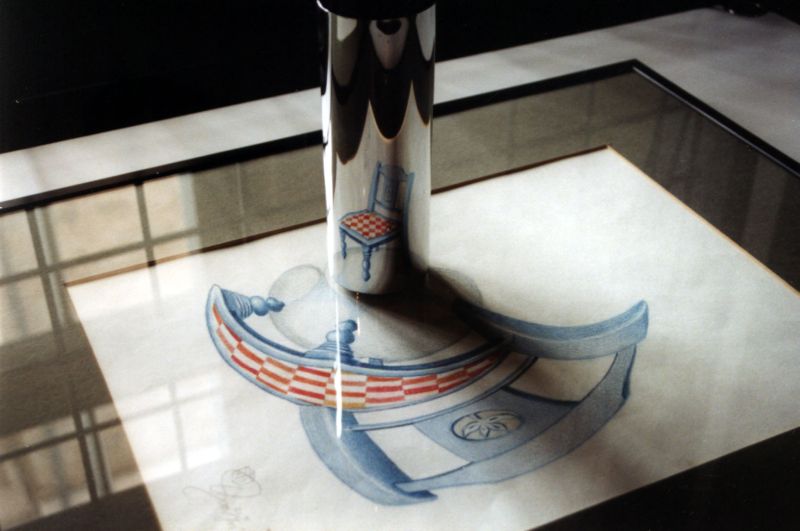
At its core, anamorphic art manipulates the principles of linear perspective. An image is stretched or compressed along a specific axis, rendering it unrecognizable in its distorted state. The viewer's perception is then corrected by viewing the artwork from a predetermined 'sweet spot' – a specific angle or distance. Alternatively, a reflective surface, such as a polished cylinder, cone, or sphere, can be placed on the artwork, and the reflection will resolve the distorted image into its intended form. This optical trickery relies on precise geometric calculations to ensure that the viewer's eye, or the reflective surface, intercepts the projected lines of sight at the correct angle, effectively 'unbending' the image. The success of an anamorphic piece hinges on the artist's understanding of optics and spatial relationships, transforming a seemingly chaotic arrangement of lines and shapes into a coherent whole.
📊 Key Facts & Numbers
The scale of anamorphic art can be staggering. Some street art installations have covered areas exceeding 1,000 square meters, requiring months of planning and execution. For instance, the 2014 Guinness World Record for the largest anamorphic pavement drawing was set by a team in Dubai, measuring an impressive 1,058.4 square meters. The cost of large-scale digital anamorphic billboards can range from tens of thousands to over a million dollars per installation, reflecting the advanced technology and creative effort involved. Globally, an estimated 500-1,000 artists worldwide actively create anamorphic works, with a significant concentration in countries like the UK, South Korea, and USA. The market for anamorphic advertising alone is projected to reach billions of dollars annually by 2028.
👥 Key People & Organizations
While many artists contribute to the field, a few stand out. Julian Beever gained international fame for his intricate pavement drawings, often featuring fantastical creatures and impossible landscapes. Edgar Müller is another prominent figure, known for his hyper-realistic, large-scale 3D street art that often incorporates water or other environmental elements. In the digital realm, companies like D-Lab and Seoul Arts Center have pushed the boundaries of anamorphic projection mapping, creating immersive experiences for major events. The Royal Academy of Arts in London has also featured anamorphic works, bringing the technique to a prestigious institutional platform.
🌍 Cultural Impact & Influence
Anamorphic art has influenced visual culture, blurring the lines between art, advertising, and entertainment. Its ability to create 'wow' moments has made it a powerful tool for brands seeking to capture public attention, as seen in campaigns by Coca-Cola and Nike. Beyond commerce, it has seeped into popular culture, appearing in films like Transformers and music videos, where distorted visuals are used for dramatic effect. The technique has also inspired a generation of digital artists and designers, fostering new forms of interactive installations and augmented reality experiences. The inherent surprise and delight associated with discovering the 'real' image have cemented anamorphic art's place as a captivating and enduring visual phenomenon.
⚡ Current State & Latest Developments
The current landscape of anamorphic art is increasingly dominated by digital projection mapping and LED screens, especially in urban environments. Cities like Tokyo and New York City now feature numerous anamorphic billboards that create stunning illusions of depth and movement, often integrated with live camera feeds to make passersby part of the artwork. The integration of AI in generating and manipulating distorted imagery is an emerging trend, promising new levels of complexity and interactivity.
🤔 Controversies & Debates
The primary controversy surrounding anamorphic art often centers on its commercialization. Critics argue that its use in advertising, while effective, can trivialize the artistic origins of the technique, reducing it to a mere gimmick for product placement. There's also debate about the ethical implications of using anamorphosis to disguise potentially offensive or misleading content, a practice that dates back to its earliest uses. Furthermore, the environmental impact of large-scale digital displays, with their significant energy consumption, is a growing concern. Some purists also lament the shift from physical, hand-crafted illusions to digitally generated ones, feeling that the tactile element and the artist's direct engagement with materials are lost.
🔮 Future Outlook & Predictions
The future of anamorphic art appears inextricably linked to advancements in digital display technology and augmented reality (AR). We can expect to see more seamless integration of anamorphic visuals into public spaces, with dynamic content that responds to real-time data, weather, or even viewer proximity. The development of AR glasses and mobile devices will likely lead to a surge in 'invisible' anamorphic art, where digital distortions are overlaid onto the real world, viewable only through a screen. Artists may also explore more complex multi-perspective anamorphoses, challenging viewers to move around the artwork to discover multiple resolved images. The potential for interactive anamorphic installations, where viewers can influence the distortion and resolution, is also immense, pushing the boundaries of audience engagement.
💡 Practical Applications
Anamorphic art finds practical application across a surprising range of fields. In architecture and urban planning, it's used to create illusions of space, making cramped areas feel larger or disguising unsightly infrastructure. Advertising agencies leverage it for high-impact campaigns that generate buzz and social media sharing. In entertainment, it's employed in stage productions and theme parks to create magical, impossible scenes. Even in education, anamorphic principles can be used to teach concepts in geometry, optics, and perspective. Furthermore, the technique has been explored for camouflage purposes and in the design of specialized optical instruments, demonstrating its versatility beyond purely aesthetic pursuits.
Key Facts
- Category
- aesthetics
- Type
- concept