
Contents
Overview
The genesis of the Mahabharata is shrouded in antiquity, with traditional accounts attributing its compilation to the sage Vyasa over a period spanning centuries, possibly as early as the 8th century BCE. Its roots lie in ancient Indian oral traditions, evolving from shorter narratives and genealogical accounts into the epic form we recognize today. The text itself claims to have undergone multiple redactions, with the earliest layers likely forming around 400 BCE, and the final compilation occurring around 400 CE. The epic's narrative framework, the Kurukshetra War, is believed by many historians to be a composite memory of various tribal conflicts and political realignments in ancient northern India, reflecting the socio-political landscape of the Vedic period and the subsequent Mauryan Empire. The inclusion of diverse philosophical and mythological tales suggests a long process of accretion and synthesis from various Brahmanical and folk traditions.
⚙️ How It Works
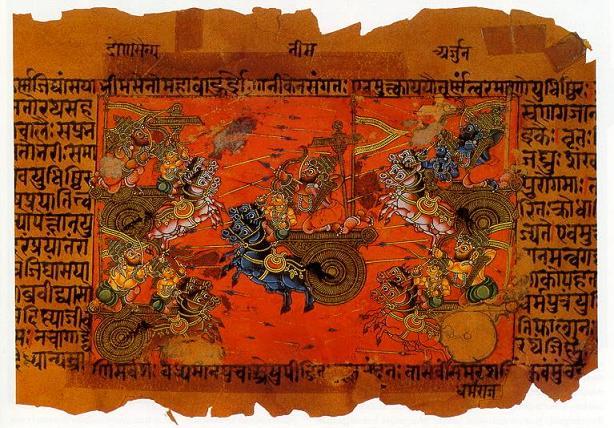
The Mahabharata functions as a complex literary and philosophical organism, structured into 18 principal books (Parvas), each containing numerous chapters and verses. Its narrative weaves together multiple storylines, often employing nested tales and dialogues to explore intricate moral dilemmas. At its core, it presents the conflict between the Pandavas, representing dharma (righteousness), and the Kauravas, embodying adharma (unrighteousness), though the lines are often blurred, forcing characters and readers alike to grapple with shades of gray. The epic's philosophical depth is most prominently displayed in the Bhagavad Gita, a dialogue between Lord Krishna and Arjuna on the eve of battle, which expounds on duty, devotion, and the nature of reality. The text also incorporates elements of cosmology, genealogy, statecraft (as seen in the Arthashastra-like discussions), and mythology, creating a comprehensive worldview.
📊 Key Facts & Numbers
The Mahabharata is colossal in scale, boasting approximately 100,000 verses, making it the longest epic poem ever composed, dwarfing Homer's Iliad and Odyssey combined. The critical edition, compiled by the Bhandarkar Oriental Research Institute, contains around 75,000 verses. It is traditionally divided into 18 Parvas, with the Bhagavad Gita being a pivotal section within the Bhishma Parva. The epic's narrative spans a period of 24,000 years, according to its own chronology, and involves a cast of over 200 principal characters. Its estimated length is about 1.8 million words, a figure that underscores its monumental status in world literature. The Harivamsa, an appendix containing genealogical accounts and mythological stories, is also considered part of the Mahabharata's extended corpus.
👥 Key People & Organizations
The central figures of the Mahabharata are the Pandava brothers—Yudhishthira, Bhima, Arjuna, Nakula, and Sahadeva—and their one hundred Kaurava cousins, led by the eldest, Duryodhana. Their divine charioteer and guide is Lord Krishna, an avatar of Vishnu, whose counsel is pivotal. Other key figures include the patriarch Bhishma, the formidable guru Drona, the tragic hero Karna, and the wise queen Draupadi. The sage Vyasa is traditionally credited with composing the epic, and his presence as a character within the narrative adds another layer of meta-commentary. The Pandavas and Kauravas represent two branches of the Kuru dynasty, a prominent lineage in ancient Indian history and mythology.
🌍 Cultural Impact & Influence
The Mahabharata's cultural footprint is immeasurable, profoundly shaping the spiritual, ethical, and artistic landscape of India and much of Southeast Asia. Its narratives and characters have been reinterpreted across millennia in literature, theatre, dance, and visual arts, from ancient temple sculptures to modern cinematic adaptations. The concept of dharma as explored in the epic has become a cornerstone of Hindu philosophy and ethics, influencing societal norms and individual conduct. The Bhagavad Gita, in particular, has achieved global recognition as a spiritual text, inspiring thinkers and leaders worldwide, including Mahatma Gandhi and Jawaharlal Nehru. Its influence extends to other Indic religions like Buddhism and Jainism, which often engage with its philosophical underpinnings and narrative motifs.
⚡ Current State & Latest Developments
In contemporary times, the Mahabharata continues to be a vibrant source of cultural engagement. New adaptations in literature, film, and television series regularly capture public imagination, introducing its complex narratives to new generations. Academic scholarship continues to analyze its historical context, literary structure, and philosophical dimensions, with ongoing debates about the historicity of the Kurukshetra War. The epic's themes of conflict resolution, ethical leadership, and the consequences of unchecked ambition remain highly relevant in discussions of geopolitics, business ethics, and personal development, ensuring its enduring presence in global discourse.
🤔 Controversies & Debates
The Mahabharata is not without its controversies, primarily revolving around its historicity and the interpretation of its moral complexities. Skeptics question the literal truth of its divine interventions and supernatural events, viewing it more as a mythological allegory than a historical account. The epic's portrayal of characters and events is often debated; for instance, the righteousness of the Pandavas and the villainy of the Kauravas are not always clear-cut, leading to discussions about moral relativism and the subjective nature of dharma. The traditional attribution to a single author, Vyasa, is also challenged by scholars who point to the epic's layered composition, suggesting it is a product of collective authorship and gradual evolution over centuries. Furthermore, interpretations of its social commentary, particularly regarding caste and gender roles, are subjects of ongoing critical analysis.
🔮 Future Outlook & Predictions
The future of the Mahabharata lies in its continued adaptation and reinterpretation, reflecting contemporary concerns and values. As global interest in Eastern philosophies and narratives grows, the epic is likely to find new audiences and inspire further creative works across diverse media. Scholars will continue to explore its textual variations and historical context, potentially uncovering new insights into ancient Indian society and thought. The philosophical teachings of the Bhagavad Gita are expected to remain a significant source of spiritual guidance, potentially influencing new schools of thought or interfaith dialogues. The epic's enduring themes of conflict, duty, and redemption suggest it will continue to resonate with human experiences, offering timeless wisdom for navigating complex challenges.
💡 Practical Applications
The Mahabharata's practical applications are vast, extending far beyond its religious and literary significance. Its intricate narratives serve as case studies in leadership, strategy, and conflict resolution, offering lessons applicable to business, politics, and personal relationships. The philosophical dialogues, particularly from the Bhagavad Gita, provide frameworks for ethical decision-making, stress management, and personal growth, influencing fields like positive psychology and mindfulness practices. The epic's exploration of human psychology, motivations, and the consequences of actions offers profound insights into the human condition, making it a valuable resource for therapists, counselors, and educators. Its stories are frequently used in corporate training programs to illustrate principles of teamwork, loyalty, and the impact of ethical choices.
Key Facts
- Category
- culture
- Type
- topic